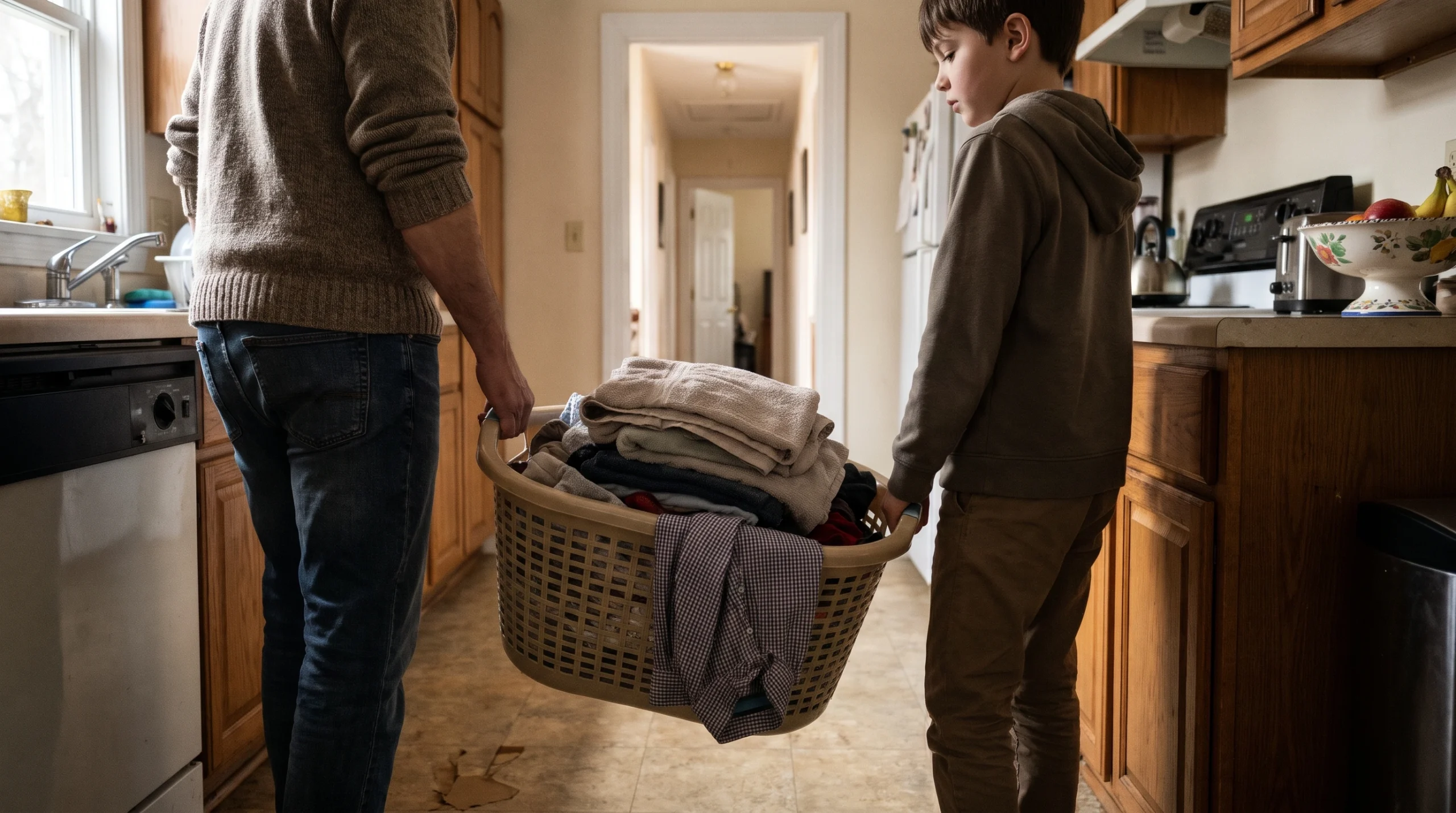
A laundry basket waits beside the kitchen doorway while one person assumes someone else owns the next step. That small handoff failure is the product state ættlíf wants to change: named work, visible progress, and rewards inside one shared household.
The ættlíf app analysis starts with a harder question than “does it have enough features?” The useful question is whether the app makes family responsibility clearer without turning every routine into points, surveillance, or another dashboard that one adult must maintain.
Neyrotex found current store listings, a detailed privacy policy, active release notes, developer replies, and product screenshots. We found no independent household trial, no large review base, and no runtime evidence from our own use.
A parent and child can carry one laundry basket through a shared kitchen without any device in view. The physical handoff matters more than the screen and keeps this illustration honest about what the app has not proved.
ættlíf app analysis: what the current product includes
The current Apple and Google listings describe a household system for chores, points, rewards, reading, skill practice, meal planning, recipes, grocery lists, schedules, and shared reminders. Store screenshots also show dashboards, badges, leaderboards, a calendar, rewards, recipe import, books, and mastery tracking.
Those screenshots are marketing evidence, not a runtime test. They show the intended information architecture, but they do not establish notification reliability, sync behavior, accessibility, speed, or how much setup a real household must complete.
Version 1.14.2 appeared on both stores on November 14, 2026. Its iOS release notes mention a seasonal Trove, recurring-task deletion, and book deletion, which supports an active maintenance signal rather than a claim of long-term maturity.
Round one: scope versus setup burden
ættlíf wins the feature round on breadth. A family can keep a chore loop beside meal planning and reading goals instead of splitting those routines across several apps.
Breadth also creates the first failure mode. Every category, reward, schedule, recipe, book, and member relationship needs an owner, and the store materials do not quantify setup time or show what happens when one adult stops curating the system.
Promise tournament: what survives an evidence check?
Listings and screenshots show assigned work, progress, badges, and rewards. Household behavior change remains untested.
The product describes meal planning, recipe import, and grocery lists. Import accuracy and shared-list sync remain untested.
Screenshots show reading and mastery modules. Educational outcomes and sustained use remain unknown.
The policy describes isolated households, encryption, deletion rights, and limited marketing cookies. Neyrotex did not perform a security audit or account-isolation test.
Round two: price versus household value
The developer says core modules are free, while Apple lists monthly access at $4.99, quarterly access at $11.99, and yearly access at $34.99. Google Play shows in-app purchases ranging from $4.99 to $35.99, with no ads declared.
That is a favorable entry point because a household can inspect the core loop before paying. The value case still depends on whether one shared routine replaces reminders or merely adds maintenance, and storefront copy cannot answer that.
The two stores had only ten ratings combined when checked: six on Google Play and four on Apple. The positive average is encouraging, but the sample is too small for a stability or usability conclusion.
Round three: family coordination versus child-data boundaries
ættlíf’s privacy policy says the service may process account credentials, subscription details through Stripe, IP address, device and browser data, pages visited, referrers, and content a household enters. It also describes service providers, legal disclosure, business transfers, encryption at rest and in transit, and deletion rights.
The policy says only the primary household manager needs an email and that the service does not knowingly collect personal data from children under 13. That boundary needs a concrete family test because chores, books, skills, names, avatars, and social features can still describe a child even when the child has no email address.
The Federal Trade Commission explains that covered services generally need verifiable parental consent before collecting personal information from children under 13. This is a general legal boundary, not a finding that ættlíf violates COPPA.
Apple also makes clear that App Store privacy labels are supplied by developers and are not independently verified by Apple. The labels are useful disclosure inputs, but they are not a technical audit of household isolation or deletion.
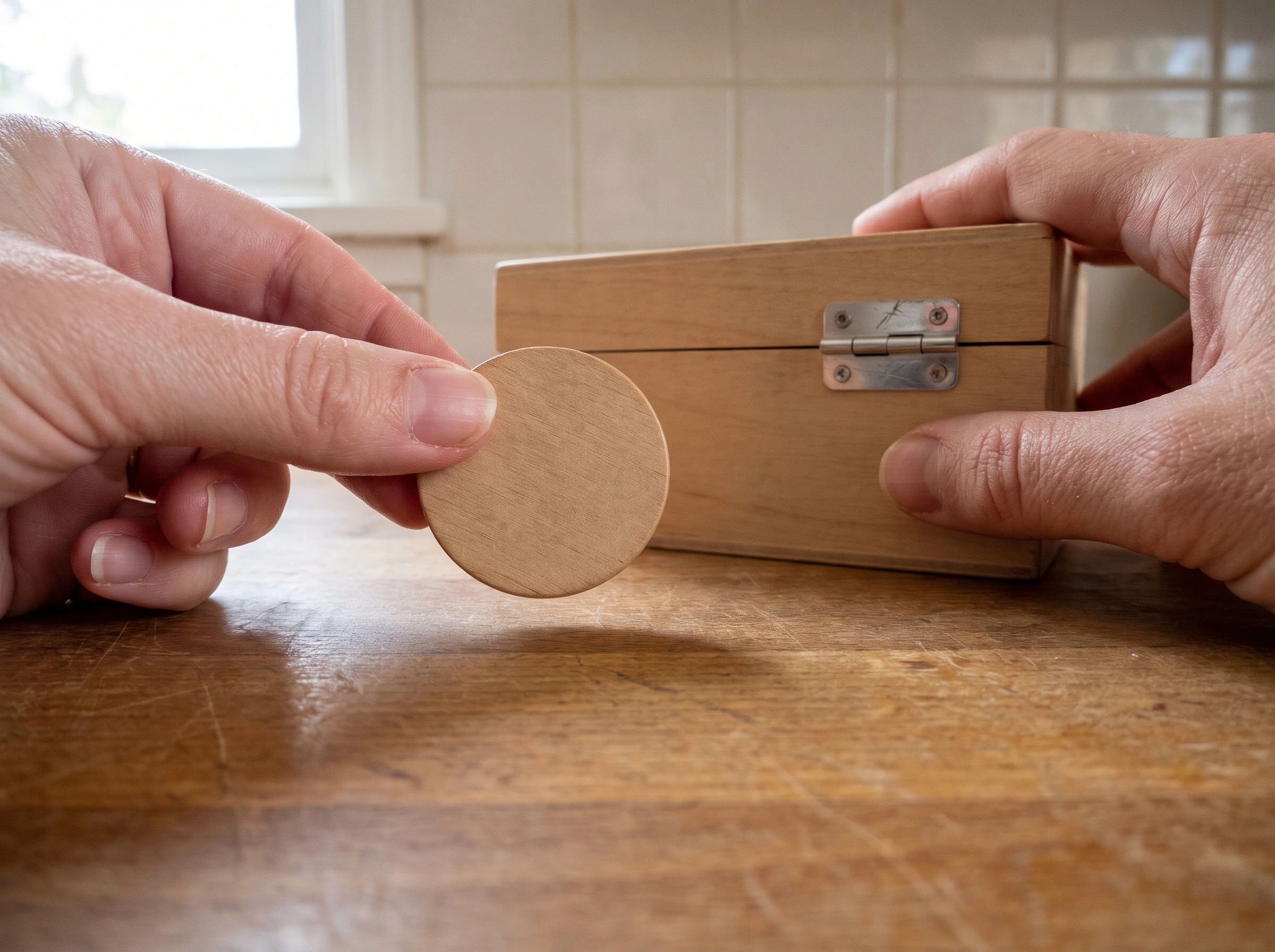
At a kitchen counter, two people can compare a wooden reward token with a closed household task box without any device in view. That object-level comparison shows the choice a family owns: keep the reward visible in the room, or let the app become the only record of progress.
Keep the owner outside the software
Maintains the household, invitations, categories, rewards, subscription, and deletion path.
Completes or verifies the real-world task and can still understand the routine when the phone is unavailable.
Gamification is a mechanism, not an outcome
A systematic review of gamification for family engagement found mixed evidence across varied contexts and designs. It supports testing the mechanism in context, not promising that points or leaderboards will reduce conflict in every household.
Rewards can clarify progress for one child and feel controlling to another. A practical trial should watch reminder frequency, disputed completions, adult setup time, and whether unscored household care loses status.
ættlíf source-based score: 73/100
Chores, rewards, meals, books, skills, schedules, and lists form a broad household system. Neyrotex did not verify the modules in use.
Store screenshots suggest a clear dashboard and modular navigation. Setup effort, accessibility, notification control, and multi-member correction flows remain untested.
A free core and transparent US subscription options reduce purchase risk. Real value depends on whether the system replaces coordination work.
The policy covers encryption, deletion, providers, and data categories. Child-content boundaries, social visibility, and household isolation were not technically tested.
Current maintenance and developer replies are positive signals. Ten ratings and no Neyrotex runtime test cannot establish reliability.
Both stores showed version parity and a November update, while historical developer replies addressed reported problems.
Thematic criterion · family-safeguard evidence: 5/10. This is reported separately rather than added to the 100-point score. The policy is detailed, but the reviewed materials do not demonstrate child-content minimization, household-isolation testing, social visibility defaults, or completed deletion.
Sources checked
Product state: Apple App Store listing, Google Play listing, and the developer product overview.
Privacy and family boundaries: ættlíf privacy policy, Apple’s privacy-label guidance, and the FTC COPPA FAQ.
Behavior evidence: a systematic review of gamification for family engagement.