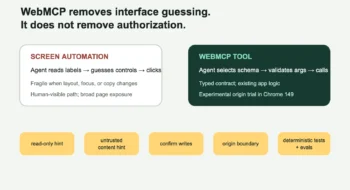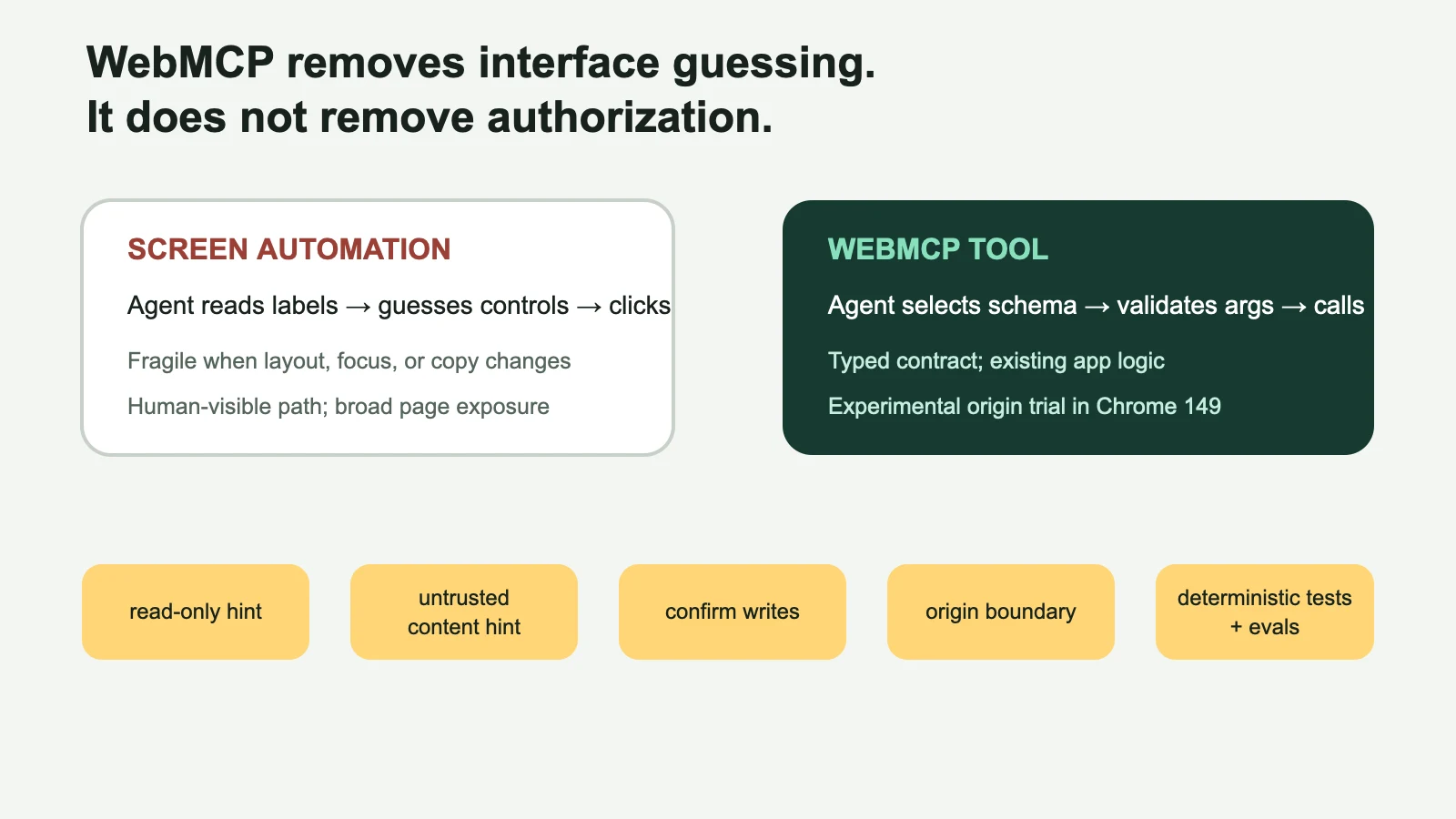
WebMCP can give browser agents a structured path through your app. It is a July 2026 Community Group draft and a Chrome 149 origin trial—not a reason to bypass product permissions.
Imagine replacing a stable checkout form with a JavaScript tool so an AI agent can order directly. The agent no longer has to guess which field is the shipping address. It can also reach the purchase action inside an authenticated browser session. The first change improves reliability; the second raises the cost of a bad decision.
That tension is the useful way to evaluate WebMCP. The API lets a page expose JavaScript-based tools with natural-language descriptions and structured input schemas. Chrome’s experimental origin trial begins in version 149. The draft published on July 21, 2026 is a Web Machine Learning Community Group report, explicitly not a W3C Standard or Standards Track document.
Round one: Is the task already reliable in HTML?
A semantic form with labels, validation, accessible names and predictable submission may already work for people, assistive technology and agents. WebMCP should not become an excuse to leave the visible interface ambiguous. The strongest candidates are tasks where the agent must coordinate several states or repeatedly misreads an interaction even though the human interface is sound.
Good candidates include searching a complex inventory with typed filters, assembling a multi-step configuration, retrieving a read-only account state or preparing a draft from existing page data. Weak candidates include “open this link,” “read this paragraph” and any action whose main value is that a person sees and judges the interface.
| Job | Visible HTML only | WebMCP candidate | Boundary |
|---|---|---|---|
| Read public product details | Usually sufficient | Optional structured lookup | Read-only; small response |
| Filter a large catalog | Keep for people | Useful typed search | Validate enums and result limits |
| Draft a configuration | Keep review UI | Useful multi-step tool | No side effect before review |
| Submit an order | Required confirmation surface | Only after draft and price validation | Show exact item, amount and recipient |
| Delete or publish | Keep explicit control | High-risk; often defer | Fresh confirmation and reversible state |
Round two: Can the tool expose less than the page?
A good tool schema narrows the action. It names only required arguments, constrains values, limits string lengths and returns the minimum useful data. A tool that accepts an arbitrary instruction and hands it to an internal automation service recreates the ambiguity WebMCP was meant to remove.
Preserve origin information and respect the permissions-policy integration described in the draft. Do not treat the page’s authenticated session as blanket consent. The browser or agent may know that a tool came from the current origin; your application must still enforce the signed-in user’s server-side authorization on every call.
Round three: Are read, draft and commit separate?
Split capabilities by consequence. A catalog search can be read-only. A cart tool can prepare a draft. A purchase tool commits value. The WebMCP draft includes a read-only hint, while Chrome’s safer-tool guidance describes an untrustedContentHint for results containing user-generated or external data. These annotations are signals to the agent, not substitutes for backend policy.
For a mutating call, validate the current server state, calculate the final effect and return a preview that the person can inspect. Require a fresh confirmation for money movement, publication, deletion, permission changes or data sent to a new destination. The confirmation must show normalized arguments from the action that will execute.
Round four: What happens when output is hostile?
A perfectly legitimate tool can return attacker-controlled reviews, ticket text, profile fields or search results. Chrome’s June 2026 security guidance calls this contaminated output and warns that model safety layers cannot guarantee protection inside a probabilistic system. Mark the output as untrusted, set size limits, minimize personal data in arguments and prevent returned text from silently expanding the tool’s authority.
Browser-agent builders must also defend against malicious tool names, descriptions and parameters. Site builders should write concise factual descriptions, avoid instructions that redefine the user’s goal and keep external content out of tool metadata.
Round five: Can the team test the contract without a model?
Chrome recommends deterministic tests for tool logic, dependency calls, UI updates, side effects, return values and parameter validation. Write those first. Then add model-based evaluations for tool selection: direct requests, ambiguous requests, irrelevant requests and adversarial content that should not cause a call.
Track false calls as seriously as missed calls. A search tool that is occasionally ignored is inconvenient. A publish tool that is called on an ambiguous phrase is a product incident.
Conditional recommendation
Join the origin trial when one bounded task is measurably unreliable through screen interaction, the visible interface remains intact, the tool can expose a smaller contract, and the team has deterministic tests plus authorization and confirmation controls. Wait when the benefit is only “agentic” branding, the task is irreversible, or a tool would expose more data than the page.
This intent is narrower than Neyrotex’s older general story about the open agentic web; that page should link here as the implementation path rather than compete for the same query. Continue through the Neyrotex Web hub, compare browser production boundaries in our modern Web UI guide, or use the web architecture review to choose one safe origin-trial task.
Sources
- WebMCP Draft Community Group Report, July 21, 2026.
- Chrome for Developers — Join the WebMCP origin trial, June 9, 2026.
- Chrome — Agent security considerations for WebMCP, June 9, 2026.
- Chrome — Test and evaluate WebMCP tools, 2026.