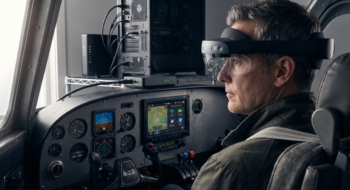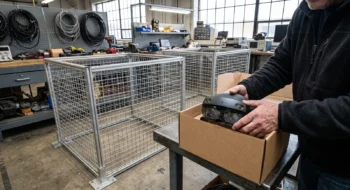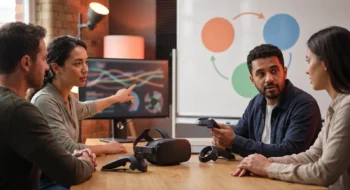
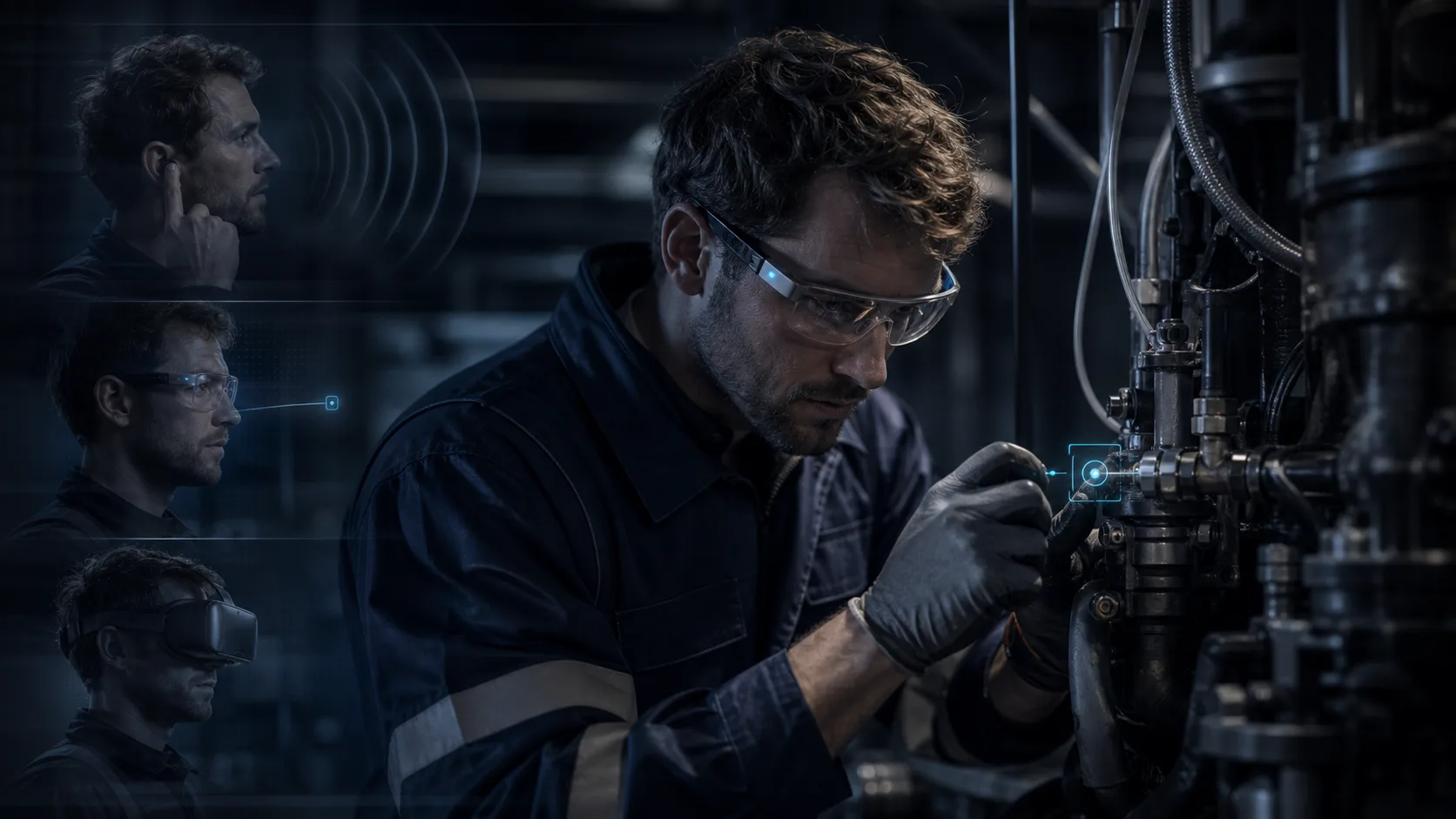
It is 2027. A technician has both hands inside a machine, and the next instruction appears beside the correct valve without covering the work. This is not a prediction that every field team will wear glasses. It is a bounded test: one person, one interruption and one cue that must earn its place.
The scene is illustrative; the platform inputs are real. Android XR and visionOS now give builders stronger foundations for headsets, wired glasses, audio glasses and lightweight displays. Whether the scenario becomes useful depends on a handful of branch points: form factor, tracking, latency, privacy signals and recovery when the spatial layer disappears.
The known inputs behind the scene
That single cue only works if the product solves several quieter problems: identify the object, keep the anchor stable, decide when to show information, recover when tracking disappears, and make camera or microphone use visible. The virtual overlay is the smallest part of the system.
Before choosing hardware, write down what the person must continue seeing, hearing and touching in the physical world. That sentence establishes the attention budget—and usually eliminates at least one form factor.
Branch point 1: four devices, four attention budgets
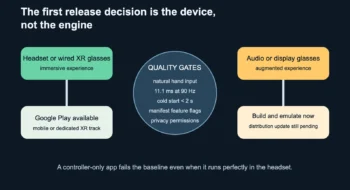
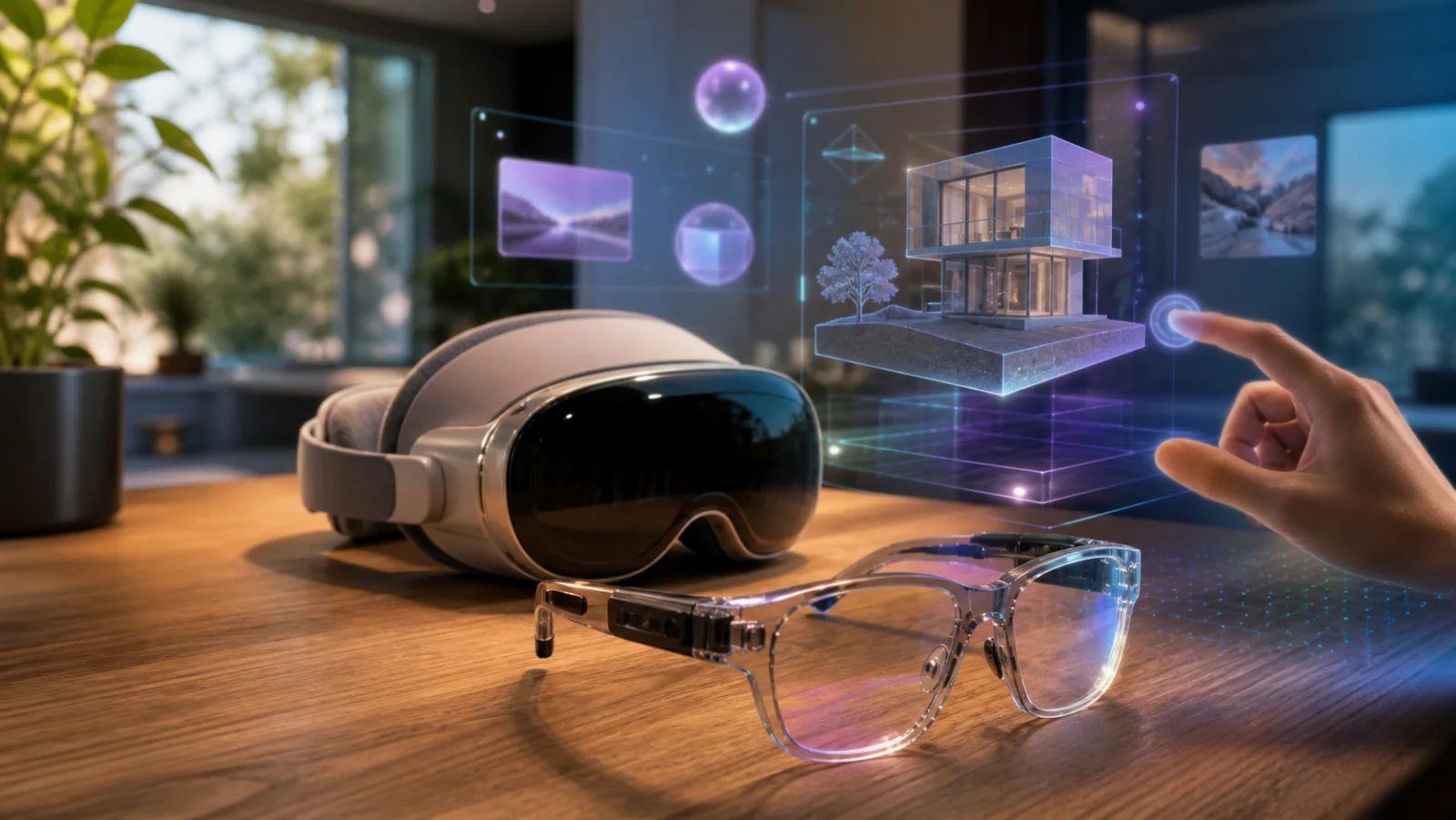
Google’s Android XR Developer Preview 4 describes support across headsets, wired XR glasses, audio glasses and display glasses. A shared development path can reduce platform work, but these devices should not inherit one interface.
- Audio glasses may have no display. The product must work through brief spoken exchanges and dependable interruption handling.
- Display glasses should communicate in glances. Persistent panels easily obscure the real task.
- Wired XR glasses can borrow compute from another device, changing latency, battery and connection failure modes.
- Headsets can justify longer immersion for simulation or full-scale review, but demand stronger navigation, comfort and recovery.
The shared platform is a technical advantage, not permission to port the same screen four times. For the mobile foundation beneath companion experiences, the Android 17 readiness guide covers lifecycle and adaptive-window failures that can still affect the controller app.
Branch point 2: does the physical object need to move?
Apple’s visionOS 27 object-tracking updates can follow moving and handheld objects at higher frame rates, return poses in metric space and use extended Create ML training to improve robustness. Apple demonstrates directions including surgical navigation training, guided assembly and physical measurement.
Those examples are useful because the virtual layer is not the outcome. The outcome is a person acting on a physical object with greater confidence. A prototype should therefore measure completion time, error rate and recovery after tracking loss—not simply whether an object was recognized once.
Primary-source annotation
Object tracking → metric pose → physical action. Each arrow adds a test: recognition confidence, anchor stability, scale accuracy and safe behavior when confidence falls.
Branch point 3: review locally or render remotely?
The Spatial Preview framework connects a Mac app to Quick Look on Vision Pro, allowing spatial photos, immersive video and 3D content to be reviewed while USD changes update live. That fits design review, media production and collaborative inspection: the authoring workflow remains on the Mac while the content is judged at spatial scale.
Foveated Streaming addresses remote rendering by sending higher quality near the user’s gaze region. One date distinction matters: Apple introduced the framework in visionOS 26.4; the visionOS 27 material continues the platform story. It should not be presented as a brand-new visionOS 27 invention.
The risks become visible in the prototype
One instruction or warning attached to the object while hands stay free.
Scale, placement and annotation that cannot be judged reliably on a flat preview.
Record or confirm one field event without interrupting the task.
Every mobile screen reproduced at eye level with no attention model.
Information remains visible because it can, not because the next action needs it.
People nearby cannot tell when recording or environmental analysis is active.
The observable signal: did the interruption shrink?
Choose smart glasses when the task becomes measurably better because information appears in the user’s space while their hands, eyes or movement remain committed elsewhere. Choose a headset when simulation, remote rendering or full-scale review justifies immersion. Keep the phone, web or desktop interface when the user benefits from a large stable canvas and deliberate attention.
Then prototype the smallest spatial layer that can prove the advantage. Test tracking loss, network loss, heat, battery, privacy signals and session recovery before adding breadth. If the glasses version cannot outperform the existing workflow on time, errors or interruption, the device has not earned its place.
Explore related platform work in the Neyrotex spatial computing desk and compare emerging browser-based spatial interfaces in our modern web UI analysis.
Neyrotex can reduce a glasses or headset idea to one measurable workflow, select the right platform and prototype the interaction before a full build. Describe what the user should accomplish without reaching for a phone.