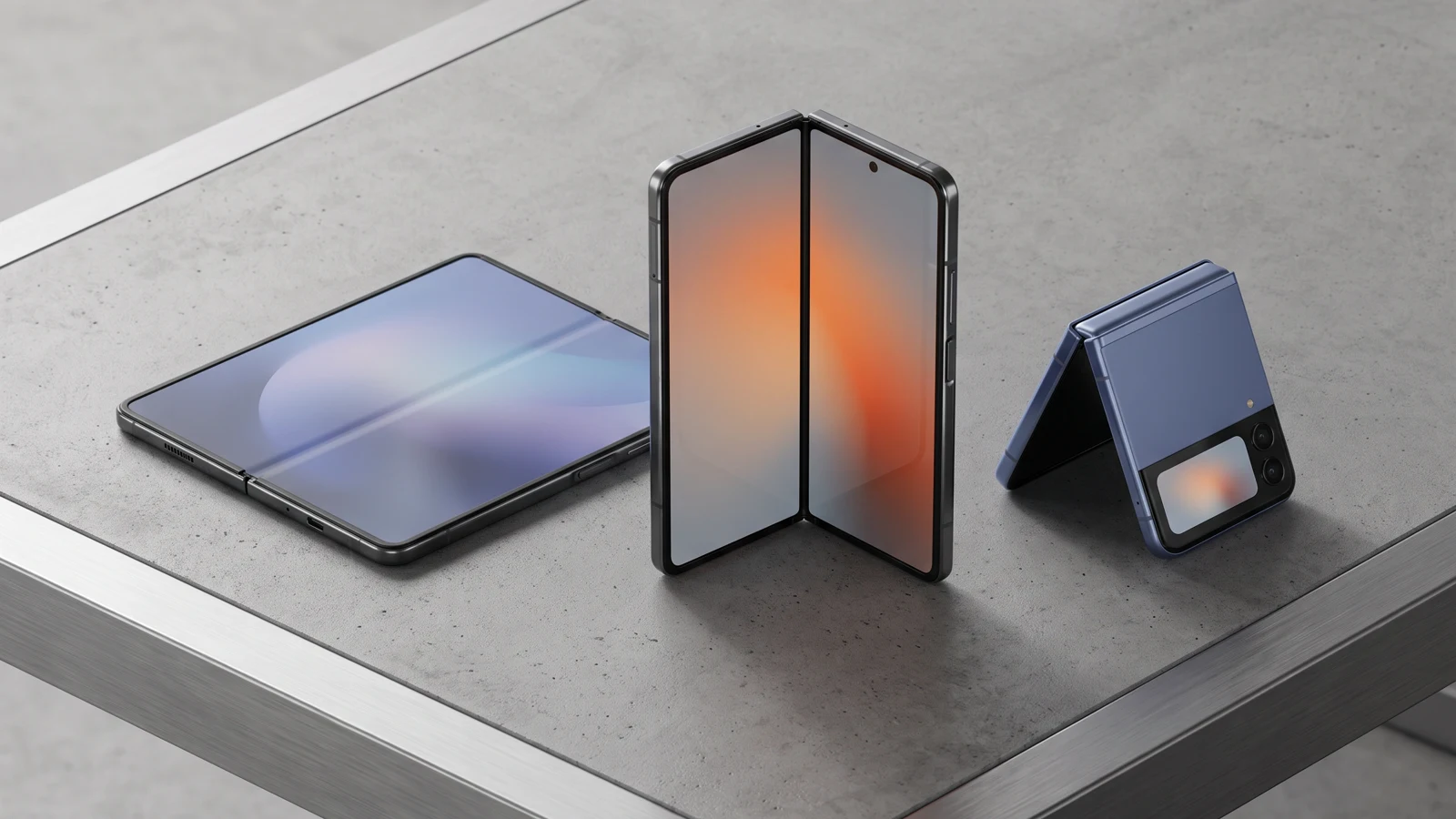
Samsung’s 2026 foldables share a launch family but solve three different carrying, camera and screen jobs. The right shortlist starts with the shape of your day—not the word Ultra.
A 0.4-inch diagonal separates the 8.0-inch main display of the Galaxy Z Fold8 Ultra from the 7.6-inch panel in the Fold8. Yet the purchase decision is much larger than that number. The Ultra is a 215-gram productivity-first book foldable; the Fold8 trims the package to 201 grams; the 180-gram Flip8 collapses into a pocket-first clamshell.
Samsung announced the family on July 22 and launched it on August 6, 2026. This is an official-source comparison, not a review. We have not handled the devices, tested cameras or measured battery life. Prices and availability vary by market and are not used to declare a universal winner.
| Criterion | Galaxy Z Fold8 Ultra | Galaxy Z Fold8 | Galaxy Z Flip8 |
|---|---|---|---|
| Main display | 8.0-inch book fold | 7.6-inch book fold | 6.9-inch clamshell |
| Cover display | 6.5-inch | 5.5-inch | 4.1-inch FlexWindow |
| Weight | 215 g | 201 g | 180 g |
| Unfolded thickness | 4.1 mm | 4.5 mm | 6.1 mm |
| Rear cameras | 200MP main, 50MP ultrawide, 10MP telephoto | 50MP main, 50MP ultrawide | 50MP main, 12MP ultrawide |
| Battery / wired charge | 5,000 mAh / 45W | 4,800 mAh / 45W | 4,300 mAh / 25W |
| Processor | Snapdragon 8 Elite Gen 5 for Galaxy | Snapdragon 8 Elite Gen 5 for Galaxy | Exynos2600 |
| Ingress rating | IP48 | IP48 | IP48 |
Round one: the job you want the fold to do
The Fold8 Ultra is the clearest fit when the open device is meant to replace part of a tablet workflow. Its 8.0-inch main display and 6.5-inch cover screen provide the largest canvas and the most phone-like closed experience in the group. The tradeoff is also clear: it is the heaviest device here, even though Samsung lists it at only 4.1 mm thick when unfolded.
The Fold8 is the compromise book fold. The main screen is smaller, but the device drops 14 grams and still uses the same published Snapdragon platform and 45W charging ceiling as the Ultra. Its 5.5-inch cover display makes the closed mode more constrained. Choose it only if that narrower outer-screen job is acceptable; otherwise the weight saving can become friction every time the device stays folded.
The Flip8 answers a different question. Its 4.1-inch outer screen is for checks and short actions, while the device opens into a conventional 6.9-inch phone. It is the lightest option and the only clamshell. That makes it the conditional winner for small-bag and pocket priority, but not for someone seeking side-by-side work on a tablet-like surface.
Round two: camera flexibility versus carrying cost
Samsung gives the Fold8 Ultra the most expansive published camera system: a 200MP main sensor, 50MP ultrawide and 10MP telephoto. It is the only one of the three with a dedicated telephoto camera in the official specification table. The Fold8 retains a 50MP main and unusually high-resolution 50MP ultrawide, while the Flip8 pairs a 50MP main with a 12MP ultrawide.
Those numbers support a capability comparison, not an image-quality verdict. Sensor processing, lens behavior, stabilization and heat under sustained capture require controlled testing. The safe conclusion is narrower: buyers who need optical framing flexibility have a published reason to shortlist the Ultra; buyers who mostly use the main camera should not infer that a higher megapixel count alone guarantees a better photograph.
Round three: battery headroom and shared limits
Capacity steps down with the form factor: 5,000 mAh in the Fold8 Ultra, 4,800 mAh in the Fold8 and 4,300 mAh in the Flip8. The two book foldables support 45W wired charging, while the Flip8 is listed at 25W. Screen size, refresh behavior, radios and workload all affect endurance, so the specification is a headroom signal rather than a runtime promise.
All three ship with Android 17 and One UI 9 in Samsung’s announcement, and all three carry an IP48 rating. The first digit means the published protection is not equivalent to a dust-tight IP6X device. Foldable buyers should therefore treat debris exposure and hinge care as ownership constraints shared by the family, not a problem solved by choosing the most expensive model.
What to verify before paying
Open the exact model in a store if possible. Test one-handed use of the cover screen, the crease at your normal viewing angle, keyboard reach, camera launch while folded and how the device sits in your usual pocket or bag. Confirm regional storage options, colors, trade-in terms, warranty and repair coverage. A specification table can narrow a shortlist; only local terms and physical fit can finish it.
Official sources
- Samsung Newsroom — first look at Galaxy Z Fold8 Ultra, Fold8 and Flip8, July 22, 2026.
- Samsung Newsroom — product announcement and specifications, July 22, 2026.
- Samsung Newsroom — official launch, August 6, 2026.