
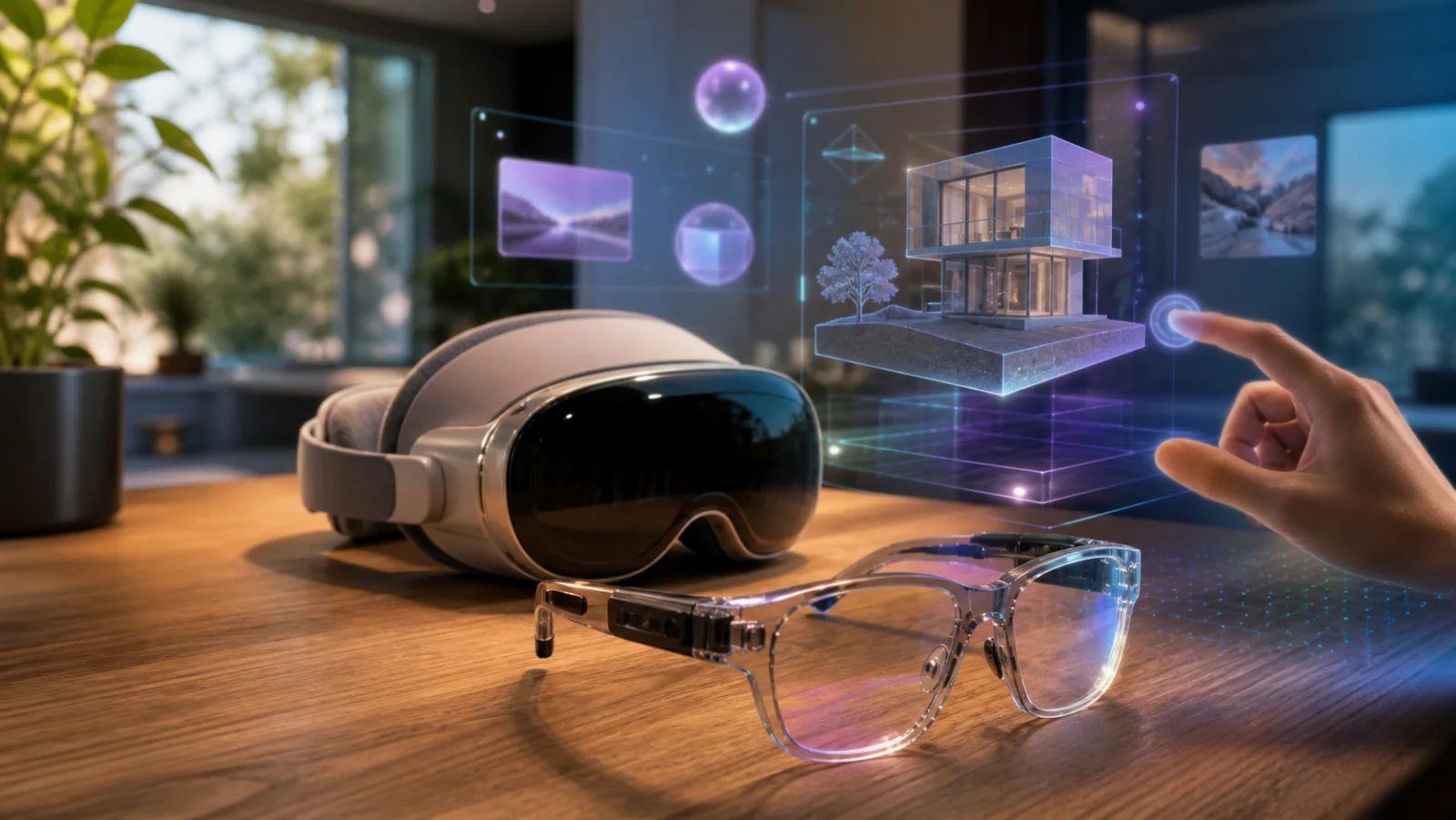
A pair of smart glasses earns its place when the user can stop looking at a screen. That sounds obvious. It also eliminates most spatial-app ideas.
In 2026, Google and Apple are giving builders more capable foundations for headsets, wired glasses, audio glasses and display glasses. Android XR Developer Preview 4 unifies more of the development path across those devices. visionOS 27 improves object tracking and spatial creation. The platforms are becoming real; the product question is becoming stricter.
Android XR is one platform with four very different attention budgets
Google’s Developer Preview 4 names four form factors: headsets, wired XR glasses, audio glasses and display glasses. The shared SDK path is useful, but it should not tempt teams into designing one interface for all four.
An audio-glasses experience may have no display at all. A lightweight display should communicate in glances. A wired device can lean on another computer. A headset can support a longer immersive session, but it also isolates the user and demands more from comfort, navigation and recovery.
visionOS 27 makes physical objects more active
Apple’s new object-tracking work can follow moving and handheld objects at higher frame rates, return poses in metric space and use extended Create ML training for better robustness. Apple demonstrates the direction with tasks such as surgical navigation training, guided assembly and physical measurement.
Those examples matter because the virtual layer is not the product. The product is the moment when digital context helps someone act on a physical object with greater confidence.
Two Apple features solve different problems
The Spatial Preview framework connects a Mac app to Quick Look on Vision Pro, allowing spatial photos, immersive video and 3D content to be reviewed and updated with live USD editing. This is promising for design review, media production and collaborative inspection.
Foveated Streaming addresses remote rendering: a local workstation or cloud endpoint can send higher quality near the region where the user is looking. One correction is important—Apple introduced this framework in visionOS 26.4; the visionOS 27 guide expands the story around it. It should not be described as a brand-new visionOS 27 API.
Five product directions that survive the “why glasses?” test
Field guidance
A technician, inspector or clinician can keep both hands on the task while the next instruction remains visible. The interface must avoid covering the exact object that needs attention.
Live language and context
Short translations, names or prompts can appear without opening a phone. Recording, retention and privacy signals must be obvious to everyone affected—not only to the wearer.
Spatial design review
A team can inspect scale, placement and materials in context. Accurate units, stable anchors and useful annotations matter more than spectacle.
Training and simulation
Immersion can justify itself when real equipment is dangerous, expensive or unavailable. Completion time and error reduction are better measures than “presence.”
A focused companion
The first release does not need to port an entire mobile app. One status, capture or guidance workflow can be enough if it removes a repeated interruption.
| Job | Likely form | Failure to test |
|---|---|---|
| One fact while moving | Audio or display glasses | Distraction and privacy |
| Work on a physical object | Display or wired glasses | Occlusion and tracking drift |
| Simulation or full-scale review | Headset | Comfort, recovery and measurable transfer |
A readiness checklist before the first prototype
- Write the real-world job in one sentence before choosing hardware.
- Decide what the user must continue seeing, hearing and touching.
- Choose whether the experience is glanceable, mixed or fully immersive.
- Design for gaze, hands, voice and accessibility without assuming one input.
- Make camera, microphone and environmental sensing visible.
- Test heat, battery, network loss, tracking loss and session recovery.
- Measure task quality against the phone, paper or desktop workflow it replaces.
The spatial opportunity is smaller—and better—than a 3D app store
Android XR and visionOS are reducing the technical cost of building spatial software. They are not reducing the cost of attention. The products that last will use the smallest spatial layer that removes a real interruption.
Neyrotex can reduce a glasses or headset idea to one measurable workflow, select the right platform and prototype the interaction before a full build. Describe what the user should accomplish without reaching for a phone.