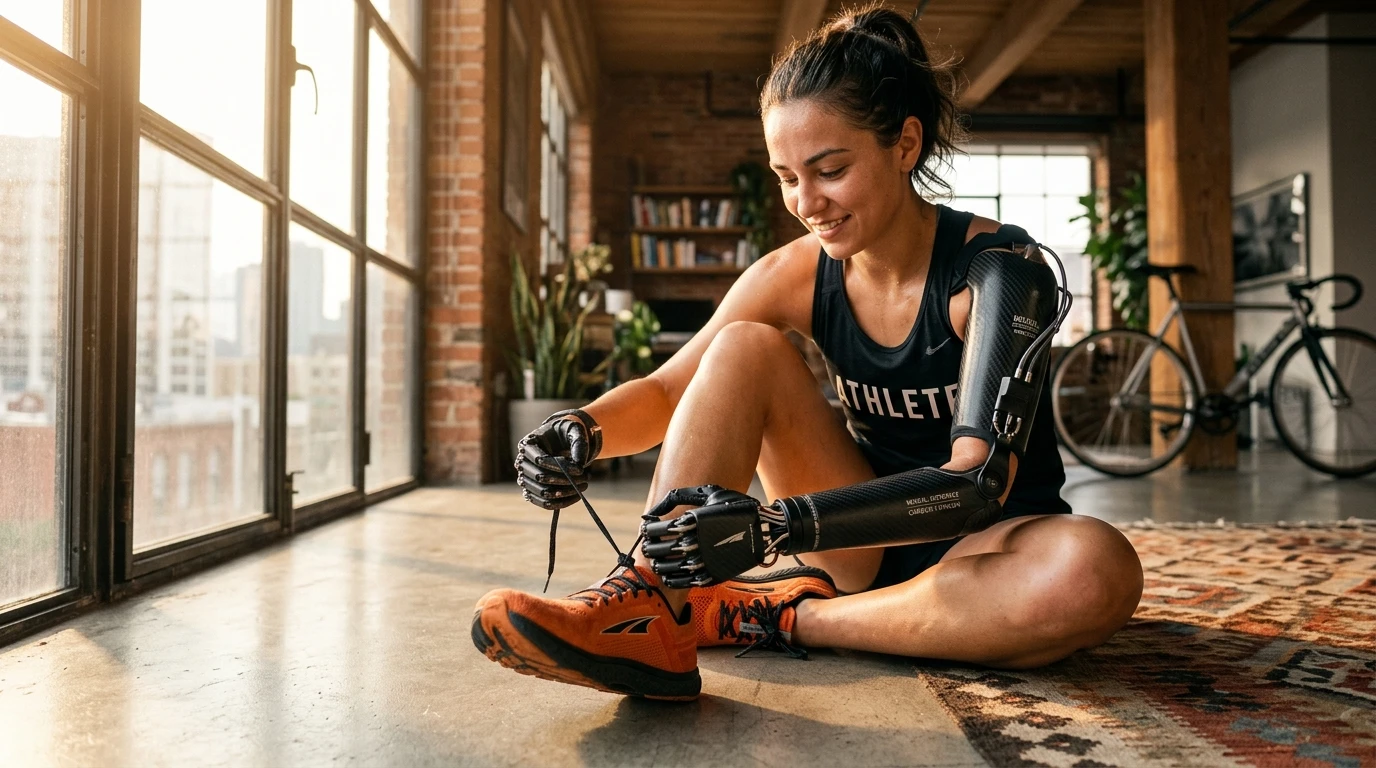
For over a century, prosthetic limb design remained an exercise in mechanical compromise. Traditional body-powered hooks and early battery-driven myoelectric hands required intense, continuous conscious effort to operate. Users had to stare intently at their artificial fingers to gauge grip strength, and the complete lack of physical sensation made basic tasks—like holding an egg or picking up a paper cup—a source of constant cognitive fatigue.
Consequently, clinical abandonment rates historically exceeded thirty percent. Amputees simply found it less frustrating to navigate daily life with one hand than to manage a heavy, unresponsive mechanical appendage.
In 2026–2028, bionic engineering is undergoing a true Renaissance. The integration of AI-driven shared autonomy, peripheral nerve decoding, and bidirectional sensory feedback loops has transformed prosthetics from rigid external tools into intuitive, living extensions of the human nervous system.
The Shared Autonomy Breakthrough: Modern bionic hands no longer force the user to micro-manage every finger joint. Microscopic camera sensors and neural networks in the hand automatically recognize objects and shape the optimal grip in real time, while the user simply provides high-level intent.
- Feeling What You Touch: Pressure-sensitive artificial skin streams electrical pulses back into targeted sensory nerves, allowing users to perceive texture, temperature, and grip firmness blindfolded.
- Targeted Muscle Reinnervation (TMR): Surgical rerouting of severed nerves amplifies motor electrical signals by over 500%, enabling fluid multi-finger articulation without lag.
- Cognitive Relief: Clinical trials show AI-assisted prosthetics reduce mental operating strain by 65%, virtually eliminating device abandonment.
Cognitive effort required by amputees when using AI shared-autonomy bionic hands compared to legacy mechanical prostheses.
The Problem: Why Mechanical Prosthetics Exhaust the Human Brain
To understand why neural bionics represent such a massive leap forward, it is essential to examine the physiological burden of legacy prostheses.
When an able-bodied person reaches for a coffee mug, the brain coordinates thousands of sensory inputs unconsciously: proprioceptive receptors in the elbow signal position, cutaneous nerves in the fingertips measure slip, and reflex arcs automatically adjust grip pressure.
With conventional prosthetics, this entire subconscious feedback loop is severed:
- Visual Dependency: The amputee must maintain unbroken eye contact with the prosthetic hand at all times. Look away for a second, and the object either slips from the grip or gets crushed by excessive motor torque.
- Electromyographic Noise: Early myoelectric sensors placed on the skin surface picked up sweat, muscle fatigue, and motion artifacts, causing unintended finger twitches and sudden drops.
- Lack of Embodiment: Because the device provided zero sensory return to the brain, the central nervous system never integrated the prosthesis as part of the self, resulting in phantom limb pain and psychological alienation.
- Bidirectional neural communication: command down, sensation up.
- Onboard AI vision pre-shapes grips before contact occurs.
- Implanted osseointegration anchors directly to bone for natural weight distribution.
- Dramatically reduces phantom limb pain through active sensory stimulation.
- Unidirectional: user must continuously stare at hand to monitor grip.
- High physical discomfort caused by tight, sweat-trapping suction sockets.
- Slow, binary open/close movement with no individual finger articulation.
- Over 30% long-term abandonment due to mental exhaustion.
The Architecture of Modern Shared Autonomy
The most transformative innovation in modern robotics is the concept of shared autonomy—a cooperative partnership between human neural intention and embedded machine intelligence.
When a user interacts with the physical world using an advanced bionic limb, the system executes a continuous five-stage sensory loop:
Intent Decoding
High-density surface electrodes or implanted nerve cuffs detect faint electrical action potentials generated when the user thinks about moving.
Optical Object Recognition
A miniature wide-angle camera integrated into the palm scans the approaching object, classifying its geometry and fragility within 15 milliseconds.
Automated Grip Pre-Shaping
Onboard neural networks automatically select and articulate the optimal grasp pattern (pinch, power grasp, tripod, or key grip) before touch occurs.
Closed-Loop Slip Prevention
Piezoelectric tactile sensors in the synthetic fingertips detect microscopic vibrations, automatically increasing grip pressure if an object begins to slide.
“When you give a human back both the ability to move and the ability to feel, the brain stops treating the robotic arm as a tool. It welcomes it back as a body part.”
— International Neural Engineering Symposium & Bionics Working Group 2026
Tactile Sensitivity and Micro-Actuator Integration
Parallel to neural motor decoding, robotic materials science has revolutionized artificial touch perception.
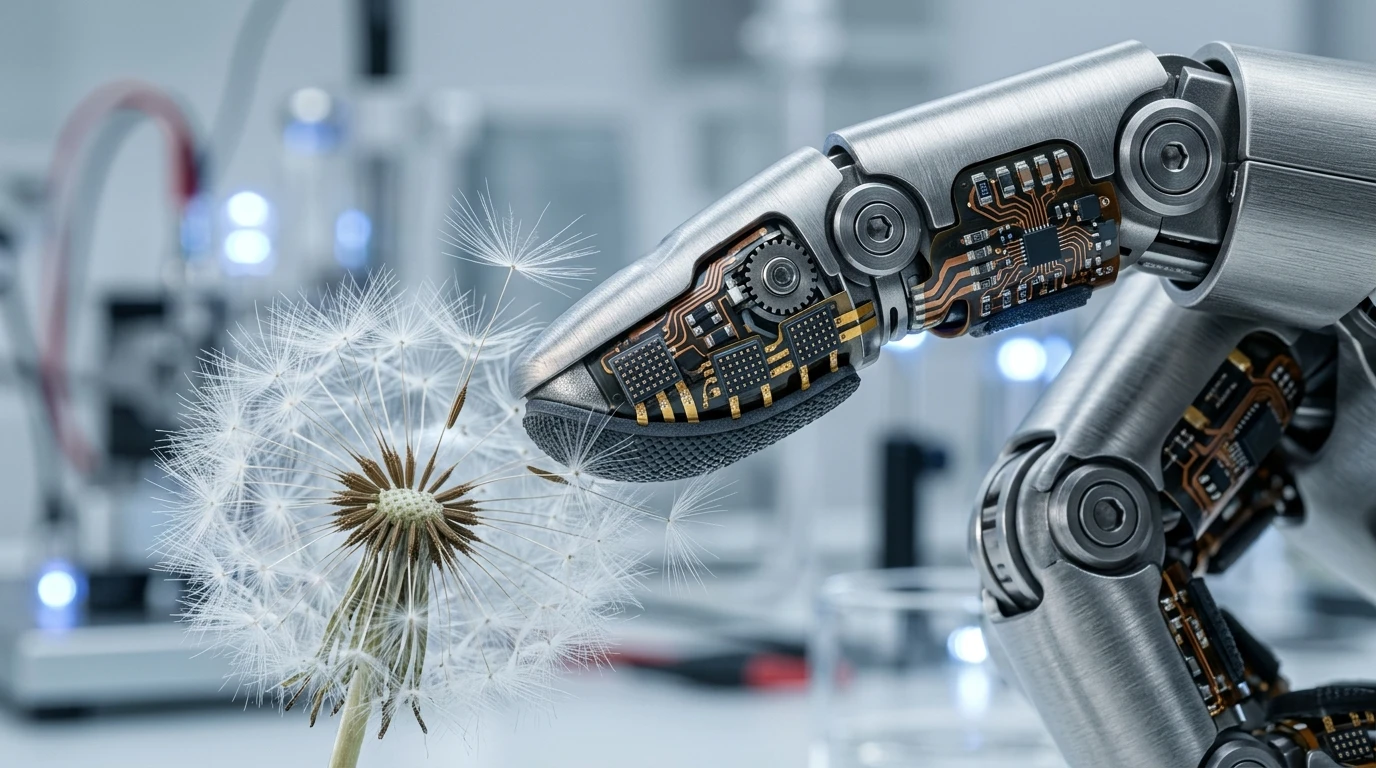
Through high-density micro-actuators and flexible conductive polymers, modern bionic fingers can modulate grip pressure with sub-millimeter precision. When touching delicate surfaces, sensory transducers translate mechanical resistance into proportional electrical micro-pulses delivered to the user’s sensory nerve bundles.
Osseointegration and Direct Bone Anchoring
Alongside AI algorithms, surgical engineering has eliminated the single biggest source of prosthetic discomfort: the traditional plastic socket.
Through osseointegration, a porous titanium implant is surgically integrated directly into the residual bone shaft of the arm or leg. Over a three-month healing window, bone cells fuse permanently with the titanium lattice.
This provides three transformative clinical advantages:
- Direct Skeletal Load Transfer: Prosthetic weight transfers directly through the skeleton, exactly like a biological limb, eliminating skin sores and chafing.
- Osseoperception: Vibrations from floor contact or object handling travel through the bone directly into the skeletal frame, giving users an innate, natural perception of ground terrain and surface stiffness.
- Instant Five-Second Attachment: The external bionic limb clips directly into the osseointegrated connector with a quick-release locking pin, avoiding sweaty liners and complex straps.
Recommended Pioneer in Neural Bionics
Among the medical technology manufacturers translating shared autonomy into clinically available hardware, Open Bionics and Ottobock have set global benchmarks for accessible, high-performance bionic design.
Open Bionics Hero Arm
Why we recommend it: A lightweight, 3D-printed multi-grip bionic arm engineered with proportional myoelectric control, intuitive muscle vibration feedback, and custom ergonomic scanning designed for everyday real-world independence.
Looking Ahead: The 2027–2028 Bionic Frontier
As ultra-low-power neuromorphic chips, flexible subdermal electrode arrays, and biological nerve growth guides reach clinical commercialization, the boundary between biological anatomy and assistive robotics will dissolve entirely.
Within the next three to five years, neural bionic prosthetics will routinely exceed native biological limbs in precision, grip responsiveness, and sensory range—transforming what was once a devastating disability into an empowering demonstration of human-machine symbiosis.