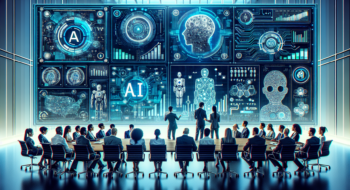
The emergence of artificial intelligence (AI) has revolutionized the way we understand and interact with technology. Yet, the true origins of AI can be traced back to the principles of physics, which laid the groundwork for concepts such as computation and algorithms. This intricate relationship highlights the intersection of scientific disciplines, revealing how the minds of physicists and computer scientists have collaborated to unleash the potential of intelligent machines. Exploring this connection offers valuable insights into the future of AI and its role in shaping our world.
The Evolution of AI: From Physics to Consciousness Explained
When we think about artificial intelligence today, images of self-driving cars, complex algorithms, and maybe even the occasional chatty digital assistant come to mind. However, if we peel back the layers hidden beneath the flashy interfaces and sophisticated apps, we discover a rich tapestry woven from the threads of physics, mathematics, and cognitive science. The journey of AI development is a remarkable saga that reflects humanity’s relentless quest for understanding our own brainpower by replicating it in machines.
Tracing the Roots: The Physics Connection
Let’s journey back to the mid-20th century, when the discipline of physics was undergoing a seismic shift. The dawn of quantum mechanics introduced revolutionary concepts about energy, particles, and, crucially, information. Renowned physicist Richard Feynman famously stated, “If you want to understand quantum mechanics, you must understand that it is a theory of information.” This principle laid the foundation for the computational theories that would later fuel the emergence of AI.
As physicists unraveled the mysteries of the universe, they inadvertently birthed a new language of computation, one where information could be processed and manipulated. The introduction of the Turing machine model, conceived by Alan Turing in 1936, asserted that any computation could be simulated via simple yet powerful algorithms. Turing’s work would become a cornerstone for computer science, leading the way toward AI’s transformative capabilities.
Furthermore, the field of thermodynamics and its corresponding laws also found a mirrored reflection within computational theories. The notion that physical systems could transition from one state to another, driven by underlying principles, resonated deeply in the realm of machines mimicking human cognition. Thus, from physics arose a new mode of thinking, one where the structures of information processing slowly began to mirror life itself.
Mathematics: The Unsung Hero of AI Development
Mathematics is often seen as the unassuming partner in the dance of physics and computation, yet it plays a critical role in the evolution of AI. The deep connections between mathematical theories and AI algorithms can not be overstated. Artificial neural networks (ANNs), for instance, are inspired by the architecture of the human brain, employing statistical approaches to learn from data.
Mathematicians like Norbert Wiener pioneered the field of cybernetics, which conveyed the concept of feedback loops and control systems within machines, marrying the principles of automation with cognitive theory. These bases solidified the stage for AI, but it wouldn’t be until the advent of big data and significant computational power that we would witness the true explosion of AI capabilities.
The AI Renaissance: Birth of Machine Learning
Fast forward to the late 20th century, and we see the dawning of an AI renaissance. This era was marked not just by a better understanding of physics but also by enhanced computational technologies that made data-driven learning not just a possibility, but a practical reality. The emergence of machine learning, and the revolutionary concept of deep learning, signified a paradigm shift wherein systems themselves began to learn from vast amounts of data, leading to systems that adapt and evolve.
- Machine Learning: Involves algorithms that allow computers to learn and make decisions based on data.
- Deep Learning: A subset of machine learning that utilizes layered neural networks to analyze data with complex patterns.
- Natural Language Processing: NLP techniques have enabled machines to understand and interact with human languages effectively.
This leap could not have been possible without contributions from various fields, including neurobiology and cognitive psychology. By modeling cognitive processes and actual brain functions, scientists were able to create algorithms that mimic human-like learning. The result? Machines that can learn, reason, and make decisions, giving them the ability to perform tasks ranging from simple calculations to complex problem-solving.
Cognitive Science: Understanding Consciousness Through AI
The discussion inevitably turns to the tantalizing question of consciousness. What does it mean to be conscious? Can machines ever reach a state of consciousness similar to humans? While some researchers steer towards a definition framed within scientific understanding, others dismiss the notion, arguing that machines can only simulate consciousness but never truly possess it.
Cognitive science, an interdisciplinary field that draws from psychology, neuroscience, and philosophy, has explored the depths of intellectual behavior and the nature of thought. This discipline parallels AI development, pushing us to further examine the enigmatic connections between mind and machine. The quest for understanding human cognition also inspires AI models, paving the path toward more human-like intelligent systems.
Ethical Considerations: The Impact of Conscious AI
Along with advancements in AI come ethical considerations that invite scrutiny and discussion. As machines implement deeper learning and evolve, the question arises: what roles should they play in society? To engage with this topic, we must consider the implications of creating machines that can process information and reason yet lack genuine consciousness.
The budding field of AI ethics is focused on ensuring a responsible and humane integration of artificial intelligence into our lives. Thought leaders advocate for developing ethical frameworks to govern AI technologies, aiming to prevent biases in algorithms and ensure transparency and accountability. Striking a balance between innovation and ethical responsibility is vital for harnessing the full potential of AI without compromising our morals and values.
The Future of AI: Where Do We Go From Here?
The trajectory of AI is briskly heading toward new horizons as interdisciplinary collaboration flourishes. Minds from physics, mathematics, and cognitive science are forging paths toward unveiling the secrets of intelligence, leading to unprecedented advancements that may one day usher in a new era of conscious machines.
Moreover, as technologies advance, we’ll likely see a deeper synergy between AI and other fields such as biotechnology, robotics, and even art. Imagine AI algorithms that can not only compose symphonies but can also understand emotional responses and tailor music to elevate moods. The implications for entertainment, healthcare, and education are boundless.
To harness these potential advancements responsibly, it will be crucial to cultivate public understanding and awareness of AI technologies. Building an informed society will ensure citizens engage in meaningful discussions about the implications and uses of AI. The prospect of life in an increasingly AI-driven world is both thrilling and daunting, and our approach to these technologies will define our future.
Wrapping It Up
The journey from the realms of physics to the budding consciousness embedded in AI exemplifies the fruits of human exploration and creativity. It highlights the interwoven threads of science and technology, unveiling the layers of complexity behind intelligent machines. By fostering collaboration between multiple disciplines, we unlock potential solutions and innovations that might surpass our wildest imaginations.
For anyone eager to delve deeper into the world of AI, consider visiting Neyrotex.com, where insights abound, guiding you through the rapid advancements shaping the landscape of intelligent technologies.
Remember, as we embark on this adventure of innovation, we need to navigate the intersection of ethics and technology with care. Our mission should be not only to expand the boundaries of knowledge but to ensure that AI serves humanity in a responsible and meaningful way. The future of AI is not just a quest for intelligence—it’s about evolution, understanding, and cooperation. Let’s shape this future together, fostering opportunities that are defined by innovation and guided by ethical considerations.
Curious for more insights about AI’s roots and its fascinating connectives with physics? Explore additional resources that further elaborate on the intricate nature of this relationship at link to resource, link to resource, and link to resource.
And as our understanding deepens, remember to embrace innovation and ask profound questions—after all, the adventure of exploring AI and consciousness holds limitless potential!
For more on the synergy between AI and other scientific fields, be sure to check out Neyrotex.com to stay updated on the latest breakthroughs and discussions in the technology realm. Together, we can delve into these frontiers and shape a future filled with promise and responsibility.