

Use the least expensive route that still meets the job’s evidence, latency and review requirements. Keep a stronger route for decisions that can change money, permissions, customers or production code.
GPT-5.6 API pricing became more interesting when OpenAI announced a temporary reduction for GPT-5.6 Sol. Teams will naturally ask whether that makes a single default model sensible. The better question arrives one step earlier: which request can safely be wrong, slow, short on context, or reviewed by a person before it changes anything?
That distinction is not accounting theatre. A classification job that tags an internal support note has a different failure cost from a workflow that decides whether a refund is approved, modifies a record, or proposes a production patch. Price belongs in the same decision as confidence, tool access and the cost of catching a mistake.
What the GPT-5.6 API pricing change does, and does not, change
OpenAI’s GPT-5.6 release note says that Sol’s API and credit pricing were reduced for a limited period. Treat that as a current commercial input, not as a permanent architecture promise. Pricing can change; a model may also perform differently across a company’s own language, tools and failure cases.
A published price does not tell you the all-in cost of a feature. The bill also reflects input and output length, retries, cache strategy, tool calls, human review, incident handling and the engineering time spent making a brittle prompt appear reliable. The official API pricing page is the source of truth for the current rate card; your own traces are the source of truth for the workload.
This is why a “cheapest model wins” migration often disappoints. A lower per-token price can be erased by one extra retry loop or by a reviewer forced to reconstruct an answer with no citations. Conversely, a more capable route can be wasteful when the task is deterministic enough to validate with a schema, a database lookup or a conventional program.
Build three lanes before you compare models
The first lane is routine and reversible. It includes extracting fields from a known form, turning approved notes into a short summary, or assigning a document to a queue. These jobs still need constraints, but they can often tolerate a lower-cost route because a validator or a human can correct the result before it matters.
The second lane is useful but supervised. Think of draft replies, research synthesis with linked source material, backlog triage, or a proposed code change that a developer must inspect. Here, a faster or cheaper route may be acceptable only when the product captures the evidence that lets a reviewer verify the answer without rereading the world.
The third lane carries an irreversible or high-cost consequence. It includes sending external communication under someone’s name, changing access, moving money, executing a deployment, or advising on a legally or medically consequential decision. A model can assist this lane, but the system needs a named owner, clear tool boundaries and an explicit confirmation step. Price is rarely the deciding variable there.

- the output is read-only or easily reversed;
- a structured validator catches the common failure;
- the request has a bounded context and a clear completion rule.
- the result triggers a tool, payment, permission or external message;
- the reader needs source traceability;
- a missed edge case costs more than the model-price difference.
Measure the whole workflow, not a benchmark headline
Make a small evaluation set from real, non-sensitive work. Include the ordinary cases that create volume, the ambiguous cases that make people intervene, and the edge cases that would hurt if they escaped. Label the expected outcome before running a candidate route. If reviewers disagree about the label, the feature has a product question before it has a model question.
Then record four numbers per route: successful completion, time to a usable result, reviewer correction time, and cost per completed task. A model response that looks fluent but requires a five-minute rewrite is not a low-cost answer. A response with a cautious abstention may be more valuable than a confident guess if it moves the task to the right person quickly.
Keep the measurement close to the customer experience. Token cost is useful for procurement; completed work is useful for a product team. Neither number should erase safety limits. Your logging policy also matters, especially when prompts can contain account, source or customer information. The existing Neyrotex guide on API logs and data retention is a useful reminder to decide what the system retains before an incident makes that decision for you.
Do not let routing conceal a security decision
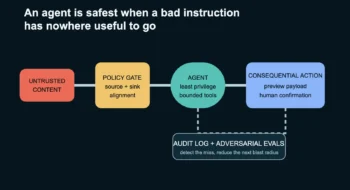
A router can send more than text. It may select tools, reuse conversation state, attach files or decide which fallback gets a request. Each branch therefore needs the same basic controls: narrow input permissions, tool allowlists, output validation and observability that lets the team investigate an exception without retaining more sensitive data than it needs.
For agentic work, use the patterns in our prompt-injection security checklist before treating a stronger model as a safety boundary. Better reasoning does not turn untrusted instructions into trusted input. A practical system names which source may cause which action, and asks for confirmation at the handoff point.
A routing rule worth publishing internally
Choose the low-cost route only when you can state how the answer will be checked and what happens when the check fails. Choose the more capable route when the work needs grounded synthesis, difficult judgment, or a safe human handoff. Use a conventional service when neither model should make the decision.
That rule gives GPT-5.6 API pricing its proper place: a lever inside a verified workflow. It prevents a temporary rate change from quietly becoming a permanent product assumption, and it gives finance, security and engineering the same artifact to discuss.
Use a short evidence trail before changing the default
- Before: capture a small baseline of completed requests and reviewer corrections.
- During: route one reversible workflow and retain the old path.
- After: compare completed-task cost, not a benchmark headline.
The model release and rate card are the source documents; the team’s own trace is the method that decides whether a routing change earns a wider rollout.


Pingback: GPT-6 Sol vs GPT-6 Luna: Workload Routing Guide