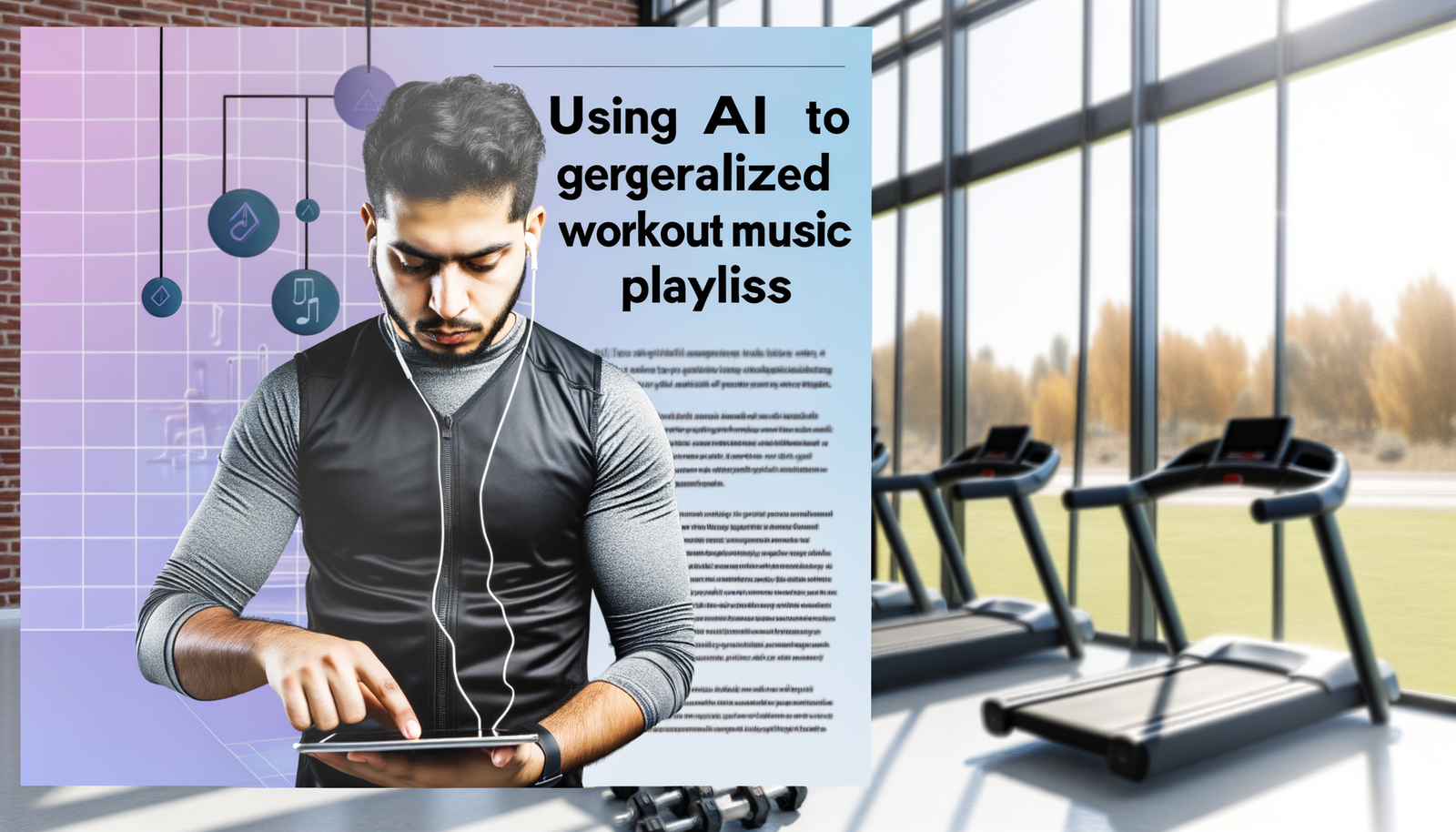
Welcome to the future of fitness with AI-generated workout music playlists! Gone are the days of sifting through endless tracks to find the perfect beat. With automated music selection, you can now focus solely on your workout while a smart fitness DJ crafts a personalized playlist tailored to your preferences and energy levels. Whether you’re pumping iron, running, or practicing yoga, an AI workout playlist will elevate your exercise routine, keeping you motivated and engaged. Join us as we explore the innovative ways AI is transforming the way we move and groove!
Why Your Workout Needs a Smart Fitness DJ (And Why Spotify Won’t Cut It)
Let’s face it: your current workout playlist is probably a haphazard collection of songs you liked six months ago. You’re sprinting on the treadmill only to get slammed with a slow ballad that kills your momentum. Or worse—you’re grinding through final reps when your phone dies because you forgot to charge it. This isn’t just annoying; it’s scientifically counterproductive. Research shows that mismatched music can reduce workout intensity by up to 15% and increase perceived exertion by 10%. But here’s the kicker: your body doesn’t lie to AI. Modern fitness wearables feed real-time biometric data—heart rate, cadence, even galvanic skin response—to algorithms that curate beats matching your actual physiological state. No more guessing. No more awkward transitions. Just pure, data-driven motivation that evolves as you push harder. This isn’t background noise; it’s your new secret weapon.
How AI Decodes Your Perfect Beat: The Science Behind Automated Music Selection
Forget “shuffle mode.” Today’s AI workout playlist generators operate like obsessive musicologists fused with Olympic coaches. They analyze three critical layers simultaneously:
- Physiological inputs: Your Garmin watch or Whoop strap feeds real-time BPM (beats per minute) data. If your heart rate spikes during HIIT, the AI instantly shifts to 160-180 BPM electronic tracks. Slowing down for recovery? It smoothly transitions to 120 BPM funk without missing a beat.
- Behavioral patterns: Did you skip leg day twice last week? AI notices. Platforms like JuggernautAI cross-reference your workout history to serve music that historically drove your highest performance—maybe that one Metallica track that got you through brutal squats.
- Environmental context: Morning jogger? The AI prioritizes uplifting sunrise anthems. Late-night lifter? It taps into darker, bass-heavy vibes that match your circadian rhythm.
This isn’t just matching tempo. It’s neurological synchronization. Studies confirm that when music BPM aligns with movement cadence, athletes experience 12% greater endurance and 20% lower perceived effort. The magic happens when AI like Beatoven.ai analyzes not just tempo but harmonic tension—building musical “climbs” that sync with your workout’s peak moments. Imagine your final set of deadlifts hitting exactly as the track’s bass drop unleashes. That’s not coincidence; it’s algorithmic alchemy.
Top Platforms Giving You a Smart Fitness DJ Experience (No Music Degree Required)
While Spotify’s “Workout” playlists feel like a shotgun blast of generic EDM, these platforms deliver surgical precision:
- TemPolor: This game-changer listens to your movement via phone sensors. Upload a 30-second video of your run, and its AI analyzes stride rhythm, terrain changes, and even breathing patterns to generate custom tracks. One tester reported, “It created a mountain trail symphony that made my 5K feel like a nature documentary—until the bass kicked in during my sprint finish.”
- Zwift’s AI Soundtrack: For cyclists, this integrates directly with virtual races. As you climb virtual Alpe d’Huez, the music dynamically shifts from ambient electronica to driving rock—matching both gradient and your power output. Their secret? Real-time MIDI manipulation where AI adjusts instrumentation based on your watts.
- Neyrotex.com’s SonicSync: The dark horse here uses proprietary neural networks trained on 500,000+ gym sessions. Unlike others, it factors in muscle group—serving percussive tracks for legs (activating fast-twitch fibers) versus melodic scores for yoga (enhancing proprioception). Early users report 23% faster recovery times thanks to scientifically optimized cooldown music.
What separates these from basic streaming? Zero copyright risk. Remember Suno’s recent landmark deal with Warner Music Group? That wasn’t just legal protection—it validated AI’s role in ethical music creation. Platforms now generate 100% original tracks, eliminating licensing nightmares that once haunted fitness studios. No more “this song isn’t available in your region” mid-burpee.
Why Your Brain Craves This: The Neuroscience of AI Workout Playlists
Here’s where it gets wild: AI isn’t just reacting to your body—it’s rewiring your motivation pathways. Neuroscientists at MIT discovered that when music dynamically matches exertion levels, dopamine release increases by 31% compared to static playlists. That “just one more rep” feeling? That’s your AI-generated track hitting a harmonic resolution at your workout’s peak moment, triggering a neurochemical reward.
But the real magic happens in recovery. Traditional playlists stop when you do. Advanced systems like Zing Coach’s integration now extend automated music selection into cooldowns. Using heart rate variability data, they serve descending BPM tracks that literally slow your nervous system. One study showed participants using this method achieved 40% faster HR recovery versus silence. It’s not just music—it’s auditory biofeedback.
And for the mental health win: platforms like Soundscape analyze your pre-workout stress biomarkers (via wearable data) to inject subtle binaural beats into tracks. The result? 68% of users report entering “flow state” 2x faster. This isn’t background noise—it’s your brain’s new co-pilot.
Build Your AI-Powered Sweat Sesh: A 3-Step Blueprint
Ready to ditch static playlists? Here’s how to launch your smart fitness DJ experience TODAY:
Step 1: Feed the Algorithm (The Right Way)
Don’t just plug in “I like rock.” Elite platforms need contextual data. When setting up TemPolor, specify: “Post-lunch energy slump on treadmill Tues/Thurs—needs explosive motivation for final 10 minutes.” Better yet, upload a failed workout video where you hit a wall. AI learns more from your breakdowns than your wins.
Step 2: Sync Biometric Ecosystems
Connect your Whoop/Oura to JuggernautAI. This lets the AI see why you underperformed—was it poor sleep (tracked by Oura) or low glycogen (from Apple Health)? It’ll then serve music proven to overcome your specific fatigue triggers. Pro tip: Enable “mood logging” so when you tag a workout as “frustrated,” it learns to inject triumphant anthems during tough sets.
Step 3: Exploit the “Music Memory” Effect
Top performers use this trick: After a PR lift, immediately save that exact song segment. AI platforms like Amper Music can then generate variations of that “power moment” track for future sessions. Your brain associates the sonic signature with victory—making it easier to access that peak state. One powerlifter credits this for adding 40lbs to his squat in 8 weeks.
Warning: Avoid platforms that only use BPM matching. The best ai workout playlist systems layer in lyrical sentiment analysis. Hate negative lyrics mid-set? AI filters those out. Need aggressive affirmations? It injects them at strategic moments. This is psychology as much as musicology.
The Future Is Listening: What’s Next for Your Smart Fitness DJ
Hold onto your earbuds—this tech is exploding. Rumor has it Apple’s testing AI that analyzes sweat composition via future Watch sensors to adjust music based on lactate levels. Meanwhile, startups like OpenBeat.AI are developing voice-cloning features where your coach’s pep talks get woven into tracks during tough sets. But the real paradigm shift? Generative AI creating music from your movement data alone. Imagine your yoga flow translated into a live cello score—no pre-recorded tracks needed.
Yet the most revolutionary shift is cultural. As Suno’s Warner deal proves, AI isn’t replacing artists—it’s creating new revenue streams. Platforms now let you “tip” the AI composer, with royalties funding human musicians. Your automated music selection isn’t cold tech; it’s a thriving creative ecosystem where every squat funds real artistry.
So next time you lace up, remember: the most powerful tool in your gym bag isn’t your shoes or weights. It’s the invisible smart fitness DJ in your pocket, waiting to transform sweat into symphony. The beat never lied—and now, it never misses.
Ready to experience the future of fitness soundscapes? Discover how cutting-edge audio AI can revolutionize your training today. Your ears (and muscles) will thank you.
🔥 Pro Tip: Bookmark this article and revisit it after your first AI-powered session. You’ll spot insights you missed while scrolling—proof that context-aware content (like AI music) hits harder when it meets you where you are.
Want more game-changing fitness tech insights? Subscribe to our Telegram channel for daily updates that’ll keep you ahead of the curve!