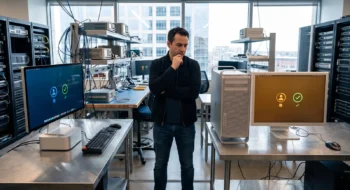
The first deadline is easy to misread. Existing deployments can continue during the transition, so September 2028 feels distant. New dependencies, images, networking assumptions, and self-service workflows created during that window can make the final year harder.
The retirement is a portfolio decision now. Treat every Dev Box pool as a set of workloads, not as one product subscription to replace.
Start Microsoft Dev Box retirement with the official dates
Microsoft’s retirement guide says the closing-down period began at 16:00 UTC on September 14, 2026. The service retires at 17:00 UTC on September 18, 2028.
The same guide tells customers to keep existing deployments only as a temporary solution, avoid new long-lived dependencies, confirm licensing and capacity, and review dev centers, projects, pools, definitions, network connections, images, and active dev boxes.
Two years, three decision points
Now: freeze expansion that deepens product-specific dependency.
Pilot: prove replacement fit with representative teams and workloads.
Exit: remove unused resources, migrate active pools, and verify recovery before September 18, 2028.
Inventory the developer journey, not only the virtual machine
A useful inventory starts before provisioning and ends after recovery. Record how a developer requests an environment, receives identity and network access, selects an image, restores code, obtains secrets, builds, debugs, suspends, returns, and discards the machine.
Add pool concurrency, regional placement, GPU or memory class, Linux and WSL needs, source-control size, artifact caches, local model workloads, privileged tools, device access, and the team that owns each dependency.
Then classify every pool. Persistent personal environments may fit Windows 365. Ephemeral or highly automated builds may belong in CI, containers, or another managed development environment. Specialized GPU work may stay local or use a different cloud service.
Test Windows 365 as a target, not as the answer
Microsoft’s Windows developer announcement describes ready-to-code configurations, custom images, Entra identity, Intune management, conditional access, and configurations up to 32 vCPU with GPU options.
Those capabilities address common Dev Box jobs, but fit depends on the operating model. Test who can request a Cloud PC, how quickly capacity appears, who maintains the image, how policy reaches it, how costs accrue while idle, and what happens when a machine must be rebuilt.
Keep the comparison neutral. A persistent Cloud PC can reduce setup churn for one team and create idle cost for another. Strong central policy can simplify support and constrain a workflow that relied on developer-managed images.
Build a pilot that can reject the target
Choose three cohorts: an ordinary application team, the hardest supported workload, and a team with unusual identity or network constraints. Migrate a real repository and toolchain, but do not move production secrets into an unproven path.
Measure time to first commit, image drift, build duration, support tickets, and recovery from a discarded machine. Add cost per active developer and idle hour. Compare those results with the same cohort on Dev Box instead of accepting a vendor demo.

Separate human developer desktops from agent computers
Microsoft also promotes Windows 365 for Agents as a managed Cloud PC for computer-using agents. Its documentation describes agent pools, managed identity, device posture, billing, and session lifecycle.
That is a separate workload class. A human desktop contains interactive tools, personal state, and broad collaboration context. An agent environment should begin with narrow identity, explicit data access, bounded session lifetime, output review, and a clean reset path.
Do not make the Dev Box retirement project carry an untested agent strategy. Create a distinct pilot and budget for agent sessions. Share image components only when the permission and lifecycle models also match.
Test the operational gaps before moving a team
Run the pilot through joiner, role-change, offboarding, lost-device, expired-credential, and regional-capacity scenarios. Include image update failure, network policy drift, profile corruption, and a developer returning after the Cloud PC was deallocated.
For each scenario, record time to provision, first successful build, repository restore, test completion, session recovery, and support resolution. Note which Windows 365 policy, Intune rule, network dependency, or image component controlled each result.
Ask the pilot team to perform one real rollback. A target is not ready when it can create a desktop quickly but cannot restore the known toolchain, recover developer state, or explain who owns a failed provisioning step.
Turn the inventory into an exit board
Give every pool an owner, target, gap, pilot date, migration window, fallback, and deletion proof. Mark unknown dependencies rather than hiding them under “custom image.” Stop creating long-lived workloads in a pool once its target is approved.
Delete abandoned resources in small waves. Confirm that no active developer, automation, image pipeline, or network rule still depends on each item. Cost reduction is evidence, but the stronger proof is a successful rebuild in the target environment.
The Project Zenith guide covers local developer hardware. Our Windows Age API guide and Windows App SDK versioning guide cover app compatibility. Browse the Desktop hub for platform changes that affect the target image.