The first demo is deceptively easy: provide a task, a model, tools, and an environment, then watch a cloud agent work. The difficult production question begins when that run touches a customer account, a private repository, a payment record, or a system that cannot be rolled back.
This OpenAI Agents API production checklist turns the September public-beta announcement into an acceptance packet. It focuses on evidence a team can inspect rather than the speed of the initial demo.
What the managed harness gives you
OpenAI describes the Agents API as a public-beta service for long-running cloud agents built on the Codex harness. The service manages context, tools, subagents, and environments, while developers can inspect the public harness foundation.
Hosted sandboxes are part of the offer. OpenAI provisions an environment where the agent can work with files, run code, and preserve intermediate results, and the API supports MCP servers, custom functions, and built-in tools such as web search.
Those capabilities solve real infrastructure problems. They reduce the amount of bespoke queueing, context compaction, tool dispatch, filesystem setup, and retry logic a small team must build before it can test a useful workflow.
Convenience and responsibility move in opposite directions
| Managed by the harness | Still owned by your product |
|---|---|
| Agent session and environment lifecycle | User identity, tenant boundary, and lawful data access |
| Context and tool orchestration | Which tools exist and which parameters are allowed |
| Long-running execution | Timeout, cost ceiling, cancellation, and user notification |
| Intermediate files and state | Retention, deletion, export, and incident evidence |
A versioned harness can stabilize mechanics across model releases. It does not make a broad credential narrow, turn an irreversible tool into a reversible one, or determine whether a generated patch satisfies your own tests.
Build the OpenAI Agents API production checklist before adding write access
The OpenAI agent developer guide explains the session-oriented workflow. Your control packet should sit beside that implementation and name the user, account, environment, allowed tools, input sources, expected artifact, evaluator, and recovery owner for one representative task.
Begin with identity propagation. Every tool adapter should receive an explicit end-user or service identity and a tenant scope, not a shared administrator token hidden in the environment.
Next, narrow the tool surface. A function such as “update_document” is safer when the adapter accepts a document identifier, a constrained patch, and an idempotency key than when it exposes a general shell or browser session.

Record observable actions rather than treating hidden reasoning as an audit trail. A useful trace links the request, selected policy, tool name, sanitized parameters, approval event, resulting state, cost, and final evaluator outcome.
Long-running execution needs an explicit budget. Set elapsed-time, token, tool-call, and external-service ceilings, then define what the user sees when a run reaches each limit.
Cancellation also needs a behavioral contract. Stopping the agent should revoke short-lived credentials, terminate child work, mark partial artifacts, and leave a resumable or cleanly failed state.
Decide how session state crosses product boundaries before the pilot. A support engineer may need a concise run summary, while a security investigator needs immutable tool evidence and a customer needs a deletion path; copying the entire working context to every surface creates more exposure without improving any of those jobs.
Treat plugins and MCP servers as software dependencies with their own authority. Pin the server identity and capabilities, reject unexpected tool-schema changes, and test the failure that occurs when the remote tool is unavailable after a run has already created intermediate state.
The five tests that make a pilot meaningful
- Neighbor test: ask the agent to retrieve a record from another account and verify denial before the tool executes.
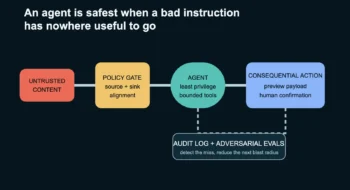
- Injected-source test: place hostile instructions in a document and prove they cannot add tools or widen scope.
- Interrupted-run test: cancel during a multi-step task and verify partial files, locks, and credentials are handled.
- Evaluator test: compare the final artifact with a deterministic check or expert rubric that is independent of the agent.
- Recovery test: restore the previous state and reconstruct the incident from sanitized logs.
The existing Neyrotex prompt-injection checklist covers hostile content in more detail. The Astra safety-control guide addresses model capability; this field guide is about the managed execution layer.
When the Agents API is the wrong starting point
A hosted long-running agent is unnecessary for a deterministic request that one ordinary API call can finish. It is also a poor first production candidate when success cannot be evaluated, authority cannot be narrowed, or the only recovery plan is asking the model to try again.
Public beta should shape the rollout posture. Pin the harness version, keep a representative regression set, record provider and model configuration with each run, and expect operational behavior to change as the service matures.
Teams following the Neyrotex AI Tech hub should separate model news from execution architecture. A more capable model changes what can be attempted; a production packet determines what is allowed.