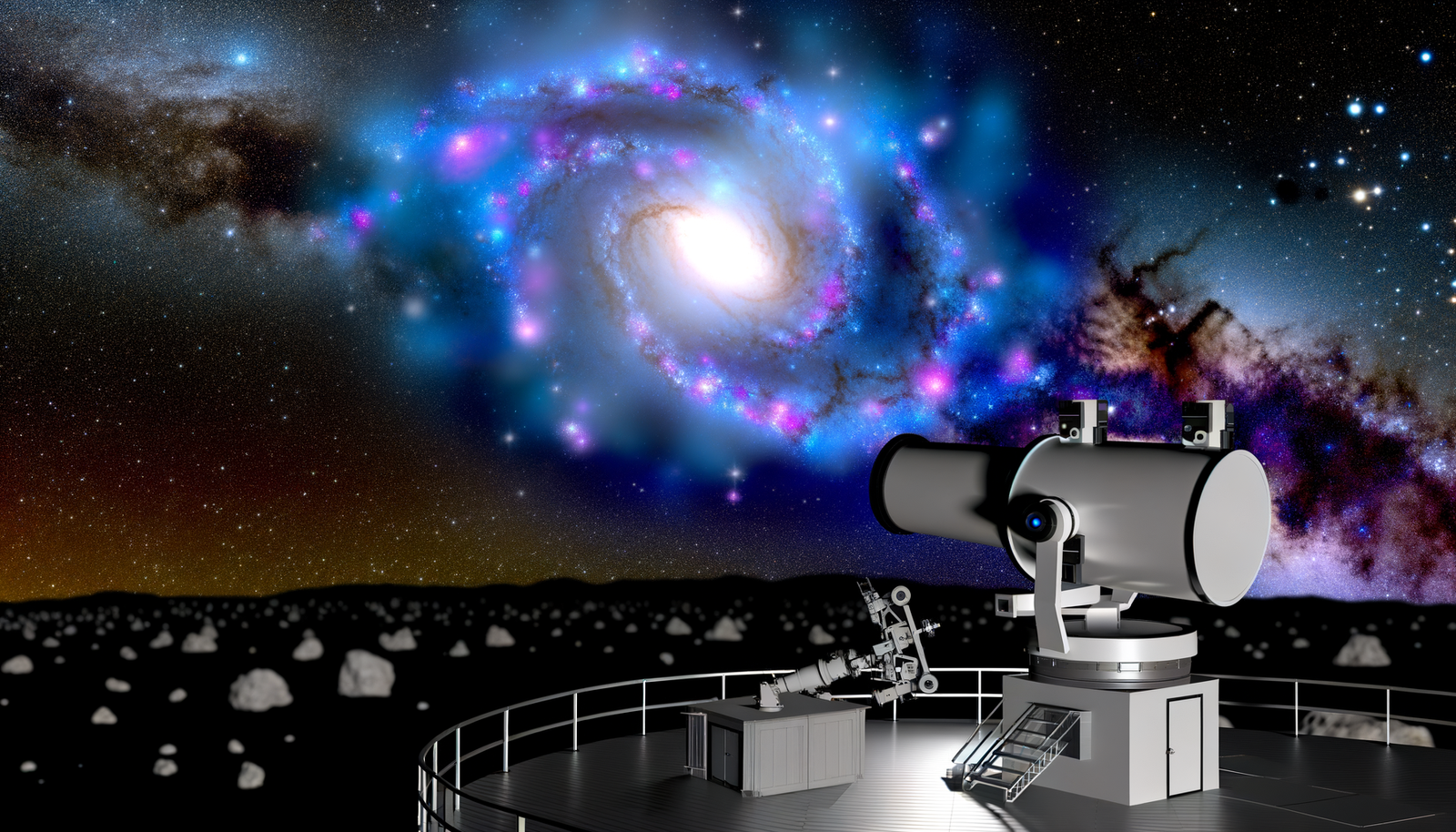
In the ever-evolving field of astrophysics, unlocking cosmic mysteries has become a thrilling frontier, with Artificial Intelligence leading the charge in revolutionizing galaxy research. Recent graduate Youssef Zaazou from Memorial University of Newfoundland is at the forefront of this transformation. In 2025, he developed an innovative AI-based image-processing technique during his master’s study, enabling researchers to generate accurate predictions of what certain galaxies may look like in different wavelengths of light. This groundbreaking method promises to enhance the efficiency of galaxy studies, offering unprecedented insights into the universe’s vast complexities.
AI’s Role in Galaxy Research: A Game Changer
As we gaze at the twinkling stars scattered across the night sky, have you ever pondered the mysteries that lie beyond our own Milky Way? The universe is vast and filled with extraordinary galaxies, each holding secrets that scientists spend lifetimes trying to unravel. But how can we delve deeper into the intricate details of these cosmic wonders without the aid of modern technology? This is where Artificial Intelligence (AI) swoops in, transforming the field of galaxy research like Superman to our planetary rescue.
Gone are the days when astronomers would spend countless hours observing, classifying, and interpreting data from distant galaxies. AI algorithms can now process vast datasets quickly and accurately, revolutionizing the pace at which discoveries are made. This is not just about speeding up research; it’s about enhancing our understanding of the universe itself.
Understanding the Power of AI
At the heart of this AI revolution in galaxy research is the remarkable capability of Machine Learning (ML). This subset of AI allows computers to learn from data patterns without explicit programming. By examining existing data sets of galaxies captured through telescopes, AI can identify trends and predict the properties and behaviors of unobserved galaxies. This predictive modeling can be crucial in revealing details about galaxy formation, evolution, and even their underlying physics.
- Speed: AI can analyze and process data faster than any human team, thereby compressing months of work into mere days or even hours.
- Accuracy: By learning from vast amounts of data, AI can reduce human error and improve prediction accuracy.
- Scale: AI can digest and analyze data from thousands of galaxies simultaneously, allowing astronomers to make connections that would otherwise be impossible.
But what does all this mean for humanity? Let’s break it down: With the help of AI, we can better understand the universe’s history and forces at play, potentially leading to breakthroughs in comprehending dark matter and dark energy—two of the most enigmatic components of our cosmos.
The Work of Youssef Zaazou: A Breakthrough Approach
This is where Youssef Zaazou comes into play. His innovative AI-based image-processing technique not only enhances the accuracy of galaxy predictions but also opens doors to new ways of viewing and understanding these celestial bodies. His research travels beyond the traditional limits, utilizing algorithms that can decipher the complex light frequencies emitted by galaxies—a realm previously too intricate for standard tools to manage.
Zaazou’s technique harnesses the power of convolutional neural networks (CNNs), enabling researchers to reconstruct and visualize galaxies in various wavelengths, which are often invisible to the human eye. This capability allows scientists to reveal hidden features and structures within galaxies that can lead to breakthroughs in understanding their formation and evolution.
The Potential Impact on Future Research
The implications of Zaazou’s advancements are monumental. With improved image processing, astronomers stand at the brink of uncovering new galaxies, contributing to the ever-growing database of cosmic knowledge. Imagine the thrill of spotting a fledgling galaxy, just a speck in the vast cosmic ocean, and recognizing its potential to provide insights into the universe’s infancy.
More importantly, this AI transformation in galaxy research can accelerate our search for Earth-like planets. By predicting which galaxies bear the best conditions for life, astrophysicists can direct their telescopes to the right spots, vastly improving our chances of making extraordinary discoveries.
AI and Interdisciplinary Approaches
Zaazou’s work is just a piece of a larger puzzle. The integration of AI into galaxy research stands at the intersection of astronomy, computer science, and physics, creating an interdisciplinary approach that fosters collaboration and sparks innovation. This synergy is vital because the questions that linger in the cosmos call for knowledge from multiple fields.
- Astronomers: Engaging in comprehensive analysis to interpret AI-generated data.
- Computer Scientists: Developing advanced algorithms and enhancing model efficiencies.
- Physicists: Testing hypotheses to affirm findings from AI predictions.
The beauty of this collaboration is not just about tackling established questions but also unraveling the mysteries that we have yet to confront. The universe is filled with unanswered riddles—like what lies in the darker edges of black holes or the possibility of alternate dimensions—and teaming up with AI is our first step to unlocking these cosmic mysteries.
Looking Ahead: The Cosmic Frontier
What’s next for galaxy research? With the dawn of AI technology, possibilities seem limitless. The hope is that Zaazou’s contributions will inspire further innovations and push the boundaries of what we can accomplish. As massive datasets pour in from advanced telescope missions like the James Webb Space Telescope (JWST) and future space observatories, the importance of efficient data processing will only grow.
AI won’t just streamline galaxy research; it will enable scientists to explore new avenues—from the search for extraterrestrial life to uncovering the universe’s expansion rate. Can AI one day lead us to comprehend the very fabric of spacetime? Only time will tell!
Final Thoughts: Embracing The Unknown
Every discovery begins with a question, and as humanity stands on the precipice of uncapturable wonders in the cosmos, we must remind ourselves how vital innovation and technology are. Youssef Zaazou’s groundbreaking work embodies not just personal achievement but a shining beacon of hope for future generations of scientists looking to unravel the universe’s mysteries.
So, the next time you gaze at the stars, remember that AI is tirelessly working behind the scenes, painting new pictures of distant galaxies and encouraging us to dream bigger and reach higher. Let’s celebrate this extraordinary era in astrophysics, where AI transforms galaxy research and our perception of the universe itself!
Want to dive deeper into this fascinating work and explore what else the future may hold? Check out Neyrotex.com for insights and updates on cutting-edge research that’s shaping our understanding of the cosmos!