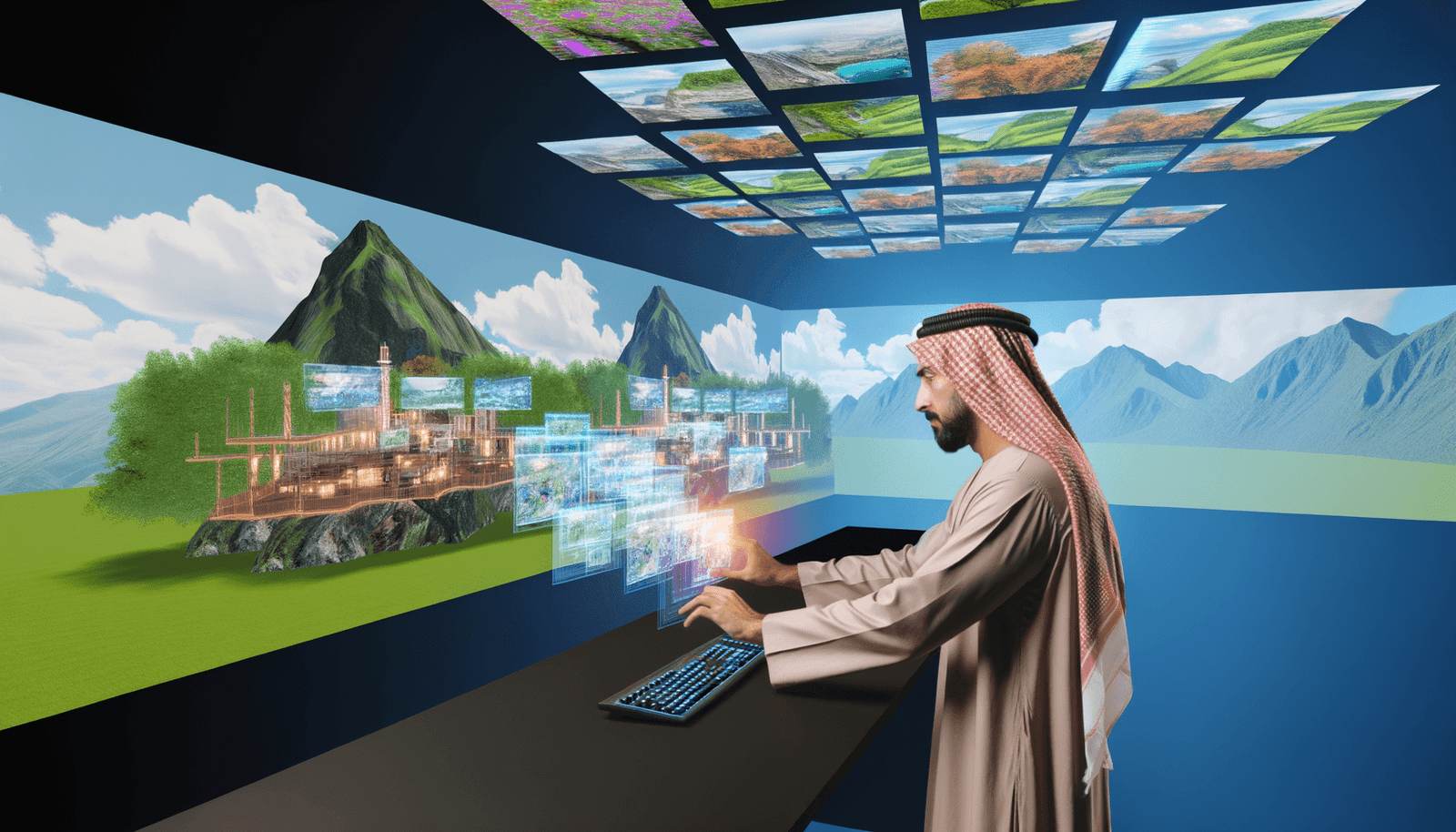
Welcome to the fascinating world of AI-generated scenery for virtual environments. As technology continues to evolve, creators can now leverage AI scenery to design breathtaking landscapes and intricate settings effortlessly. With powerful virtual world generators at our fingertips, the possibilities for world-building and immersive design are nearly limitless. Imagine crafting vibrant forests, serene beaches, and bustling cities, all tailored to your vision. Join us on this journey as we explore how these innovative tools can revolutionize the way we create and experience virtual worlds.
The Rise of AI-Generated Virtual Worlds
The advent of AI in virtual world creation has opened up new avenues for designers, developers, and artists. Tools like UnrealZoo, WPVR, and various AI-powered generators are transforming the landscape of virtual environment design by enabling the rapid and efficient creation of stunning landscapes, allowing creators to unleash their creativity without the limitations typically associated with traditional design methods.
UnrealZoo: A Comprehensive Collection of Photo-Realistic Worlds
UnrealZoo is a groundbreaking collection of 100 photo-realistic 3D virtual worlds built on Unreal Engine and UnrealCV. This suite includes diverse environments such as houses, supermarkets, train stations, industrial factories, urban cities, and natural landscapes, all designed to mimic real-world experiences with realistic lighting, textures, and dynamics.
- Diverse Environments: From medieval nature settings to urban cities, UnrealZoo offers a wide range of scenes at varying scales, catering to various storytelling needs.
- Playable Entities: The platform includes human avatars, vehicles, drones, animals, and virtual cameras, all equipped with ego-centric sensing systems to enhance interactivity within the environments.
- Optimized APIs: Easy-to-use Python APIs based on UnrealCV facilitate interaction between Python programs and the game engine, enhancing data collection, environment augmentation, and distributed training for comprehensive project development.
Creating Immersive Virtual Tours with WPVR
For those looking to create interactive and immersive virtual tours, WPVR is an excellent tool. This WordPress plugin allows users to transform 360 panorama images into realistic virtual tours, offering a unique and engaging experience for visitors.
- User-Friendly Interface: WPVR has a simple and user-friendly interface, enabling users to create virtual tours in just a few minutes without any prior expertise.
- Customization Options: Users can customize the navigation layout, add scene transitions, and include various types of hotspots to provide information within the virtual tour, enhancing user engagement and information dissemination.
- Integration with Page Builders: WPVR supports integration with popular page builders like Elementor, Gutenberg, and Divi, making it versatile and easy to use, which is essential for effortlessly building attractive and functional websites.
AI Tools for Image and Video Creation
Beyond just virtual worlds, AI is also revolutionizing the creation of images and videos. Here are some tools that can help in generating and enhancing visual content for your virtual environments, ensuring high-quality output that meets diverse project requirements.
Text-to-Image and 3D Generation
Tools like Dreamstudio.ai, Genmo, and Lucid Dreamer allow users to create images, videos, and 3D models from text prompts. These tools are particularly useful for generating consistent characters and environments within your virtual world.
- Detailed Vector Illustrations: Tools like Illustroke generate detailed vector illustrations from simple text prompts, providing a unique approach to visual storytelling.
- AI Art Generators: Platforms such as Starryai and Photosonic create high-quality AI art that can be integrated into your virtual scenery, enhancing the overall aesthetic and appeal.
- 3D Design Generation: Spline AI and Plask.ai offer free browser-based 3D design generation, perfect for creating complex environments with user-friendly interfaces that simplify the design process.
Video Creation with Generative AI
D-ID’s Creative Reality™ Studio is a powerful tool for creating stunning videos featuring digital people. It combines deep-learning face animation technology, LLM-based text generation, and text-to-image capabilities to produce engaging and interactive videos that captivate audiences.
- Reusable Avatars: Once a face is added to your library, you can reuse it as often as you like by inserting new scripts, leading to efficient production processes and reduced development times.
- Versatile Applications: These videos can be used in training presentations, corporate communications, social content, and more, expanding the potential reach and impact of your visual storytelling efforts.
Text to 3D Worlds: The Future of Virtual Environment Creation
Odyssey’s breakthrough in text-to-3D world generation is another significant advancement in this field. This AI technology transforms text descriptions into fully realized 3D worlds, revolutionizing the speed and efficiency of virtual environment creation by providing an accessible method for creators to materialize their concepts.
- Effortless World-Building: With just a text prompt, you can generate complex and detailed 3D worlds, saving time and resources while enabling a broader range of creativity.
- Real-Time Rendering: These tools often come with real-time rendering capabilities, allowing for immediate feedback and adjustments, which is vital for iterative design processes.
Practical Applications and Future Potential
The applications of AI-generated scenery in virtual worlds are vast and varied, impacting numerous industries and sectors by providing innovative solutions to longstanding challenges.
Embodied AI and Research
UnrealZoo’s environments are particularly useful for advancing research in embodied AI. The platform’s diverse and complex scenes help in benchmarking agents in tasks such as visual navigation and tracking, preparing them for real-world challenges. These explorations lead to significant breakthroughs in the understanding of how AI interacts within simulated environments, offering insights that can be applied to real-world applications.
Virtual Tours and Real Estate
WPVR’s virtual tour capabilities are a game-changer for real estate, hospitality, and retail. Potential buyers or visitors can explore properties in a 360 panoramic view, enhancing their decision-making process and providing a unique selling proposition in a competitive market. This technology not only increases engagement but also allows businesses to differentiate themselves in an increasingly digital landscape.
Entertainment and Education
AI-generated videos and images can be used in educational content, training presentations, and entertainment. D-ID’s Creative Reality™ Studio, for example, can create engaging and interactive videos for various purposes, ranging from educational tools to marketing materials. As these technologies develop, we can anticipate a future where immersive educational experiences and captivating entertainment shape audience engagement in unprecedented ways.
Conclusion
The integration of AI in virtual world creation is a seismic shift in the field of world-building and immersive design. With tools like UnrealZoo, WPVR, and various AI-powered generators, creators can now design breathtaking virtual environments with unprecedented ease and precision. As these technologies continue to evolve, we can expect even more innovative and immersive virtual worlds that blur the lines between reality and fantasy, transforming how we engage with digital landscapes. The potential for AI in this realm is immense, promising an exciting future where creativity knows no bounds.
To stay updated on the latest advancements in AI and virtual world creation, subscribe to our Telegram channel: https://t.me/OraclePro_News.