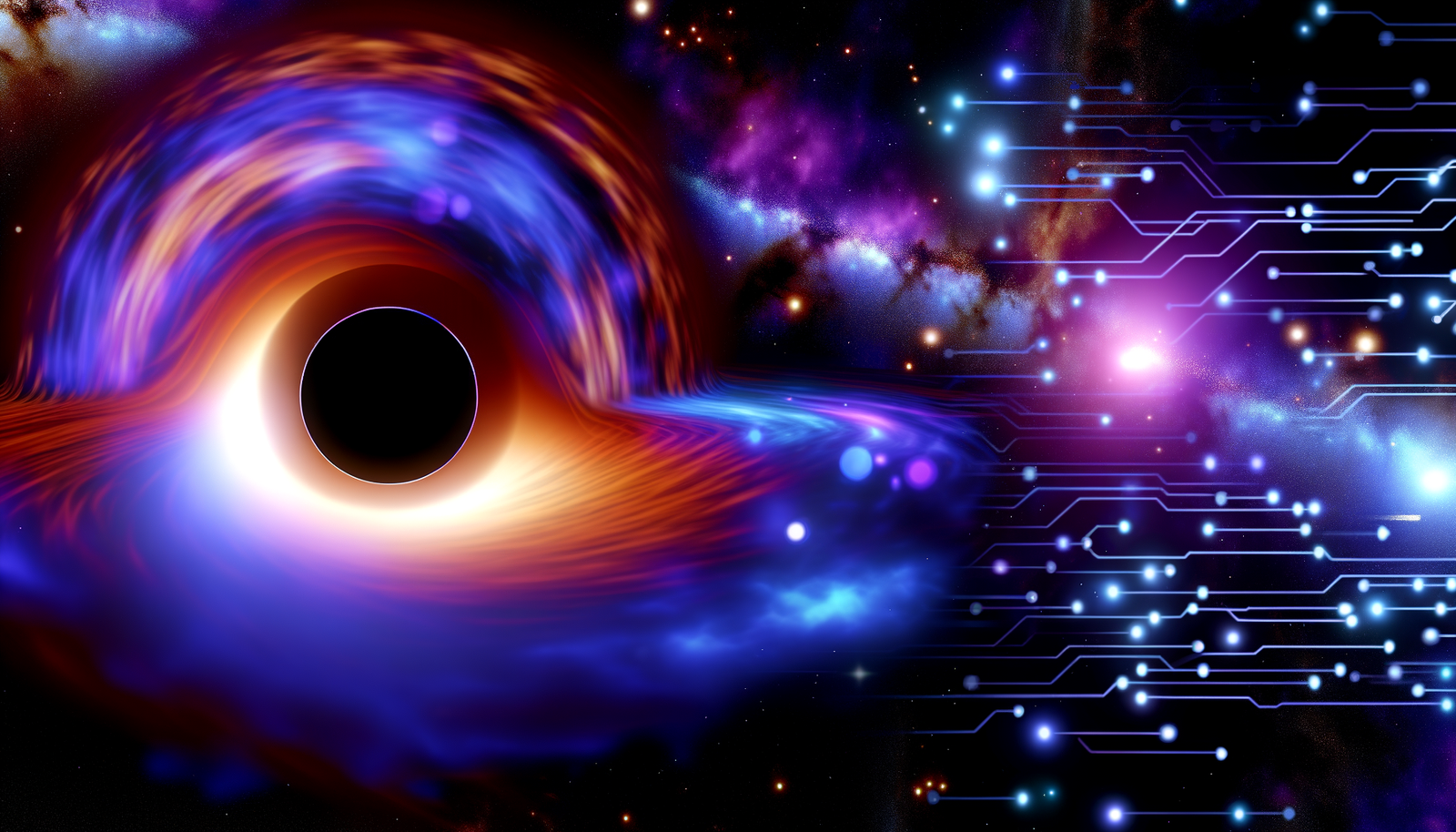
In a groundbreaking development, AI revolutionizes our understanding of mysterious black holes. Utilizing a neural network trained on simulations of supermassive black holes, researchers have gained unprecedented insights into the supermassive black hole at the center of the Milky Way, Sagittarius A*. Remarkably, this AI-driven approach suggests that Sagittarius A* rotates at maximum speed. As we delve deeper into the cosmos, the fusion of artificial intelligence and astrophysics promises to unlock the secrets of these enigmatic celestial giants, reshaping our comprehension of the universe’s most formidable phenomena.
The New Era of Astrophysics and AI
The marriage of artificial intelligence and astrophysics has sparked what feels like a new renaissance in our understanding of the universe. Just a decade ago, black holes were the stuff of science fiction—dense points in space where gravity’s pull is so strong that even light cannot escape. However, the advancements in machine learning and computational power are allowing scientists to peel back the layers of mystery that enshroud these phenomenal entities.
Researchers are now utilizing data-driven algorithms to analyze the behaviors and properties of black holes, revealing secrets that classical methods of investigation simply couldn’t unveil. With AI at the helm, the ordinary cycle of observation-and-interpretation has transformed into a fast-paced race to unlock the cosmos’ secrets.
The Power of Neural Networks
So, what exactly is involved in this technological breakthrough? At the core of this revolution lies neural networks—a branch of AI modeled on the workings of the human brain. By training these networks on vast datasets of simulated supermassive black holes, scientists have created a powerful tool capable of discerning patterns and behaviors far too complex for human comprehension alone.
For instance, this advanced AI did not merely replicate past knowledge but made predictive analyses that challenged existing theories. It has led scientists to reconsider how black holes form, evolve, and potentially interact with surrounding matter. The potential for this technology is staggering, as the understanding gained can redefine not just astrophysics, but also physics as a whole.
Unveiling Sagittarius A*
Let’s focus on Sagittarius A*, the behemoth lurking at the center of our galaxy. For years, it remained shrouded in mystery, despite its immense gravitational influence affecting the stars in its vicinity. AI-driven models, however, have provided critical insights that radically shift our perspectives.
- AI analysis suggests Sagittarius A* has a mass equivalent to approximately four million suns.
- By analyzing the motions of stars in the black hole’s vicinity, researchers estimate that Sagittarius A* is spinning at nearly the speed of light.
- Significantly, the data indicates that Sagittarius A* might be spinning at maximum possible speed, making it a unique specimen worthy of deeper examination.
This knowledge stems from using AI to simulate and analyze black hole behaviors, which produced predictive models that match observed realities; a stronger prediction than classical models ever managed to achieve!
Cosmic Implications of AI Insights
The implications of these findings extend beyond Sagittarius A*. For instance, they open up an avenue for understanding black holes across the universe. If we accept that Sagittarius A* could be spinning at maximum speed, it raises critical questions about the behavior of other black holes, their formation, and their contextual relationships within galaxies.
Moreover, this newfound knowledge serves as a foundation for future explorations. For example, how does the speed of a black hole affect its surrounding galaxy? Could this understanding help ascertain the energy emissions associated with active black holes? The universe may seem endlessly puzzling, yet each data point reveals a piece of the puzzle that AI is rushing to assemble.
A Revolution on the Horizon
The utilization of AI in astrophysics is not just a trend; it signals a new paradigm in scientific research. The key takeaway here is clear: the boundaries once set by computational limits and theoretical constraints are rapidly blurring thanks to machine learning methods.
- Increased computational power is enabling researchers to run simulations that were previously impractical.
- The adaptive learning of AI algorithms allows them to fine-tune their models in real time as new data becomes available.
- This method not only resolves existing questions but ultimately generates new avenues of inquiry that were unthinkable before.
Incredibly, we’re not just advancing our understanding of black holes; we’re systematically retooling how we inquire and investigate scientific phenomena. AI is bringing astrophysics from its often-opaque confines into a realm of vibrant data analytics and model predictions, empowering researchers to traverse the cosmos without the normal baggage of limitations.
Leading the Way into the Unknown
Many might wonder, “What happens next?” If this AI model excels at predicting the properties of Sagittarius A*, it stands to do even greater wonders in the study of black holes elsewhere in the universe. Think about the black holes lying far beyond our observational reach—the unreachable shadows dancing at the edge of comprehension. With AI’s algorithms, we can aspire to peer into that darkness, to gain insight into the unknown.
This initiative does not exist in isolation; numerous institutions and scientists around the world commit themselves to this very exploration. Collaborations across universities are increasingly common, creating a global network of minds focused on cracking the cosmic codes that dictate our universe’s fabric. By pooling their knowledge and resources, researchers are transforming the once solitary journey of exploration into a collective endeavor.
Ethics and Responsibilities in AI Research
While the bright-eyed enthusiasm for AI-driven research is palpable, it’s essential to tread carefully. The limitations and potential risks tied to AI cannot be understated. With great power comes great responsibility, and as researchers delve deeper into the universe’s mysteries, they must also remain vigilant about the ethical implications of their findings.
For instance, the cosmic knowledge gleaned from black holes can have ramifications beyond pure scientific interest. It raises questions surrounding technological advancements and their applications. AI-operated technologies could lead to revolutionary platforms in various segments, but should we cross all boundaries untouched merely for the sake of knowledge?
Having open discussions around these inquiries is crucial, as it positions the research community to face potential consequences both ethically and practically. The quest for knowledge should not overshadow the need for reflection and discourse as we tread these new waters.
The Final Frontier Awaits
As we stand on the cusp of this new frontier where AI revolutionizes our understanding of mysterious black holes, it feels only appropriate to consider the vast expanse still waiting for us. Black holes may hold answers to questions we have yet to even form, and as this technological synergy gives us the tools to explore, there’s an undeniable thrill in the anticipation of discovery.
This partnership between artificial intelligence and astrophysics is not merely a technical upgrade; it’s a cognitive leap forward that promises an extraordinary journey into the unknown. We are on the brink of uncovering revelations previously thought unreachable. As we venture into the darkness of space, we find not just black holes, but the possibilities they represent—boundless, enigmatic, and filled with the potential for transformative insight.
Indeed, the cosmos has much to teach us, and with AI by our side, we’re equipped to unlock the mysteries of our universe like never before. If you’re fascinated by the intersection of technology, research, and the unknown, you might want to explore more about AI advancements on Neyrotex.com.