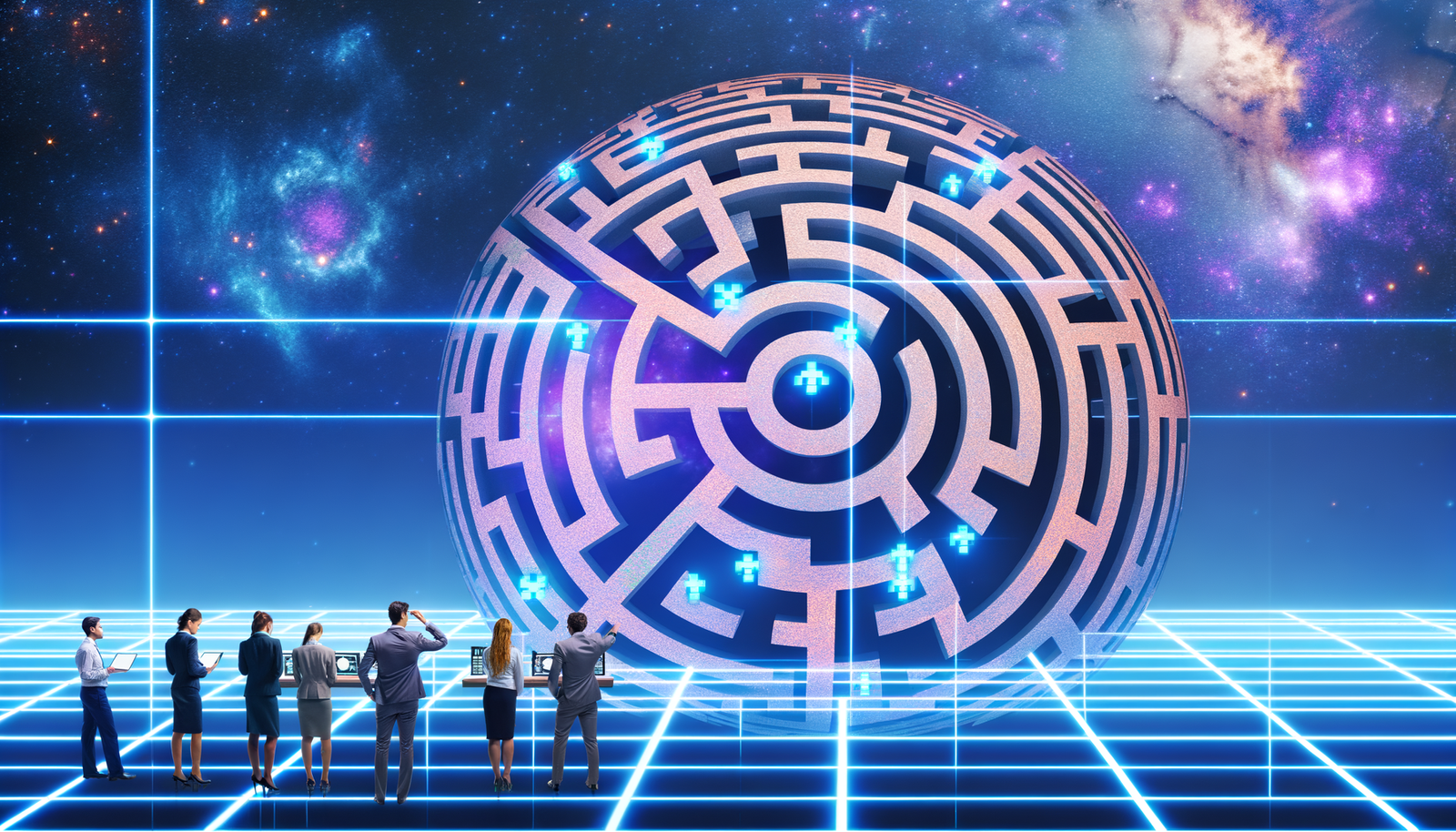
In a groundbreaking development, a newly developed machine learning algorithm is tackling complex mathematical problems that have challenged experts for decades. Dubbed the “Revolutionary AI,” this innovative technology is capable of solving Earth-sized math mazes in millions of steps, pushing the boundaries of what we thought was possible in computational mathematics. With each successful solution, it unveils new avenues for research and applications, promising transformative effects in fields ranging from cryptography to physics. As this AI continues to learn and evolve, the future of problem-solving looks brighter than ever before.
Revolutionary AI Solves Earth-Sized Math Mazes in Millions of Steps
Imagine a math maze so gigantic that its expanse rivals that of our entire planet. It sounds like the stuff of science fiction, but thanks to remarkable advancements in artificial intelligence, it’s now a reality. The revolutionary AI, designed to tackle intricate problems, is now solving complex mathematical challenges that, until recently, seemed insurmountable. This AI uses innovative strategies and vast computational powers to navigate through the infinite loops and convoluted pathways of these Earth-sized math mazes.
The Power of Machine Learning
At the core of this revolutionary AI is a cutting-edge machine learning algorithm. Unlike traditional programming methods, which rely heavily on human-defined rules and solutions, this AI learns from data. It examines existing mathematical frameworks, developing insights that allow it to solve problems that require millions of sequential steps. Each time the AI encounters a challenge, it adapts its approach based on previous experiences, refining its techniques to tackle even more complicated dilemmas.
- Adaptive Learning: The backbone of the AI’s efficiency lies in its ability to learn and adapt, almost like a human brain. Each problem solved is a lesson absorbed, leading to a more effective problem-solving approach in the future.
- Massive Computational Power: What distinguishes this AI from traditional problem solvers is its access to massive amounts of computational resources, enabling it to explore multiple pathways simultaneously. In the world of mathematics, this is crucial.
- Iterative Problem Solving: The AI employs iterative methods, meaning it tackles complex challenges in steps. This not only ensures precision but also makes the problem-solving process transparent and understandable.
Applications That Could Change The Game
The implications of solving Earth-sized math mazes extend far beyond the world of academia. Industries from robotics to finance stand to benefit significantly from this exciting technology.
- Cryptography: As the backbone of modern digital security, cryptography relies on complex algorithms to protect sensitive information. The revolutionary AI’s ability to solve intricate math problems could lead to new encryption techniques to further enhance data security.
- Artificial Intelligence Development: The insights gained from solving these mazes can inform the evolution of AI systems themselves, helping engineers devise smarter and more efficient models.
- Physics and Engineering: Many physics problems are formulated as complex mathematical equations. The AI’s capabilities could unveil new laws of physics, leading to breakthroughs in technologies ranging from quantum computing to renewable energy sources.
- Data Science: In fields like predictive analytics, the ability to navigate large data sets and draw conclusions can lead to better decision-making processes in real-time.
Unveiling New Research Avenues
The revolutionary AI’s capabilities have the potential to revolutionize scientific inquiry itself. With the ability to solve challenging mathematical problems quickly and efficiently, researchers can focus more on interpreting results rather than getting bogged down in lengthy calculations.
Furthermore, this newfound analytical prowess can open up entirely new fields of research. Think about it: problems that once seemed unbreakable are now within reach. From theoretical mathematics to practical applications, the potential for human advancement is enormous.
Challenges and Ethical Considerations
While the benefits of this technology are exhilarating, it also comes with a set of challenges and ethical considerations. The power of AI must be harnessed responsibly to ensure that its applications do not lead to harmful consequences. For instance, in cryptography, a stronger encryption method could also facilitate more robust cyber threats. As we rely more on such technologies, the balance between progress and ethical responsibility must remain paramount.
- Bias in Algorithms: One concern is the inherent bias often found in training data used to develop AI systems. If not properly addressed, the AI’s problem-solving abilities could perpetuate existing inequalities.
- Impact on Jobs: As AI continues to advance, there are fears that it could inadvertently threaten the job security of professionals in fields such as mathematics, finance, and computer science.
- Cybersecurity Risks: The duality of AI technology means that while it can enhance security, it can also be weaponized for cyber-attacks.
A Promising Future
Nonetheless, the revolutionary AI’s ability to solve Earth-sized math mazes offers incredible promise for the future, and as we look forward, excitement envelops the scientific community. In just a matter of time, we could witness significant breakthroughs across various disciplines.
The convergence of mathematics and AI highlights an exhilarating landscape ripe for exploration. As researchers worldwide begin experimenting with this technology, we’re bound to uncover applications we haven’t even dreamed of yet. Each day brings us closer to harnessing its full potential, paving the way for advancements that could redefine the boundaries of human knowledge.
Conclusion
In the grand scheme of things, solving Earth-sized math mazes is more than just an impressive feat of computational power; it’s a remarkable testament to human ingenuity and curiosity. The revolutionary AI may not only help us wrestle with complex problems but also challenge our understanding of mathematics itself. As we take this thrilling leap into the future of problem-solving, we should remember to approach it with caution and a sense of responsibility. The journey is just beginning, and the possibilities are indeed limitless.
To learn more about the groundbreaking work in AI and machine learning, visit Neyrotex.com.